I recently read and reviewed Eclipse Lake by Mae Clair for Rosie’s Book Review Team.
Here’s my review (5 Stars)
A dramatic and heart warming tale of forgiveness, love and redemption.
Dane is the successful and millionaire CEO of a security company in San Diego. He’s been a widower for three years, and lives with Jesse, the teenage child he adopted when he was six years old and married his mother.
He’s never told Jesse about his past, until the day he takes him for a visit to Onyx, the small town in Pennsylvania he left fifteen years ago, when he was seventeen.
‘You told me your parents were dead.’ (says his son)
‘Sometimes people say things because it’s easier than explaining the truth.’
Dane has been telling plenty of lies to his son, especially by omitting details about his past, but the time has come for Jesse to own up and make peace with his dark teenage years.
His parents are dead, but his only sibling, Jonah, a Park warden at the beautiful Eclipse Lake resort, the local tourist attraction, is very much alive and not pleased to see his rebellious and criminal brother at all.
Once there, the reader will meet all the other locals, the teenagers such as Page and Zach, who will befriend Jesse, the unfriendly sheriff, April, the deputy, and Ellie, a photojournalist who will become a significant person in Dane and Jesse’s lives.
Coinciding with their arrival, a skeleton is found at Eclipse Lake, initiating a murder investigation, which directly affects Jesse and his family.
This beautiful novel is a family drama, a crime story, a romance, and a young adult novel, all rolled into one.
It deals with themes such as redemption, honesty, friendship, mature love and relationships, adolescent relationships, and complex family dynamics.
At the centre of the story is the relationship between Jesse, Jonah, and Dane. It’s about the relationships between brothers, between father and son, and uncle and nephew.
It’s a dramatic, but also heart warming story about second chances, forgiveness, redemption and the power of romantic, filial and brotherly love.
Eclipse Lake is so well written that by the time I finished reading, I felt I knew the characters and had even visited Onyx and Eclipse Lake, myself.
It was a pleasure to read and review for Rosie’s Book Review Team (#RBRT).
Mae Clair opened a Pandora’s Box of characters when she was a child and never looked back. Her father, an artist who tinkered with writing, encouraged her to create make-believe worlds by spinning tales of far-off places on summer nights beneath the stars.
Mae loves creating character-driven fiction in settings that vary from contemporary to mythical. Wherever her pen takes her, she flavors her stories with conflict, mystery and a dash of romance. Married to her high school sweetheart, she lives in Pennsylvania and is passionate about folklore, old photographs, a good Maine lobster tail and cats.
February 16, 2017 prompt: In 99 words (no more, no less) write a story that includes a watcher. Respond by February 21, 2017 to be included in the compilation (published February 22). Rules are here. All writers are welcome!
Here’s my take:
Watching the Hanging
‘We’re going to Horsemonger Lane, Boys,’ said Fagin.
Dodger pulled away. ‘Ain’t nothing there except Southwark prison.’
‘A public hanging!’ said Fagin.
When they arrived, the street was teaming with watchers, howling, screeching and yelling like animals.
Oliver gasped. The place was crawling with thieves and prostitutes fighting and shouting obscenities.
‘Might as well get some work done. Look, there’s a fancy looking toff over there,’ said Fagin, pointing to Charles Dickens.
‘Bet I can half inch his bread and honey,’ bragged Dodger.
‘Watch the hanging carefully, boys,’ warned Fagin. ‘Remember, if you get caught you’ll be brown bread.’
****
Some words explained:
Toff (Victorian slang) = rich man
Half inch (cockney slang) = pinch (London/UK slang) = steal
Brown bread (cockney slang) = dead
The former flash fiction was inspired by a real event, which took place in London in 1849.
Dickens attended the execution of Mr. And Mrs. Manning, convicted of murdering a friend and stealing his money, on November 13, 1849 at the Horsemonger Lane Gaol in Southwark.
It was called the “Hanging of the Century” at the time because it was the first husband and wife execution in 150 years. Dickens and a huge crowd of rowdy, blood-thirsty Londoners (between 30 and 50 thousand) watched the public execution, performed outside the prison.
Maria and Frederick Manning.
Dickens wrote a scathing letter to The Times condemning the crowd, which can be read at the end of this post.
There were thousands of public hangings in the UK in the 19th century (more figures here). It was indeed a harrowing practice, meant to deter possible criminals, although it actually had the opposite effect. Pickpockets, prostitutes, and all types of petty criminals gathered around the event to carry out their illicit jobs. The police were enormously relieved when public hangings were abolished in England and Scotland, in 1868, because they drew huge crowds and greatly altered public order.
Public executions, and other types of punishment, have been part of most world cultures over the centuries. Looking back always makes me think what a long way we’ve come in Europe, from being the bloodthirsty barbarian spectators at the Roman coliseum, through public punishments such as whippings, the stocks, the pillory, to abolishing capital punishment altogether from our legal system in the 20th century.
Conclusion: violence does not deter violence, it breeds violence.
I’ve learnt over time, that all problems have simple solutions, or none at all:
If there’s a solution, Education is almost always the answer.
It’s a simple solution, but it’s not cheap to organise and offer or easy to train teachers and reach students, nevertheless it’s always worthwhile and rewarding.
Children without an education, like Oliver and Dodger in Victorian England, stood a 50% chance of being hanged or imprisoned, as Dodger will no doubt be in the future, as Bill Sykes and Fagin were, or ‘saved’ by a kinder, more socially conscious society, who will educate them and enable them to lead criminal free lives, like Oliver.
I’ve also included Dickens’ letter condemning the event, below.
English novelist Charles Dickens (1812 – 1870), circa 1860. (Photo by John & Charles Watkins/Hulton Archive/Getty Images)
Some people at the time, and even today, unbelievably accuse him of being bloodthirsty himself, for watching the hanging. Well, that’s like accusing a war correspondent of enjoying a war; a bit of twisted logic, I’d say.
Dickens’ letter to The Times Nov. 13, 1849
I was a witness of the execution at Horsemonger Lane this morning. I went there with the intention of observing the crowd gathered to behold it, and I had excellent opportunities of doing so, at intervals all through the night, and continuously from day-break until after the spectacle was over… I believe that a sight so inconceivably awful as the wickedness and levity of the immense crowd collected at that execution this morning could be imagined by no man, and could be presented in no heathen land under the sun. The horrors of the gibbet and of the crime which brought the wretched murderers to it faded in my mind before the atrocious bearing, looks, and language of the assembled spectators. When I came upon the scene at midnight, the shrillness of the cries and howls that were raised from time to time, denoting that they came from a concourse of boys and girls already assembled in the best places, made my blood run cold. As the night went on, screeching, and laughing, and yelling in strong chorus of parodies on negro melodies, with substitutions of ‘Mrs. Manning’ for ‘Susannah’, and the like, were added to these. When the day dawned, thieves, low prostitutes, ruffians, and vagabonds of every kind, flocked on to the ground, with every variety of offensive and foul behaviour. Fightings, faintings, whistlings, imitations of Punch, brutal jokes, tumultuous demonstrations of indecent delight when swooning women were dragged out of the crowd by the police, with their dresses disordered, gave a new zest to the general entertainment. When the sun rose brightly-as it did-it gilded thousands upon thousands of upturned faces, so inexpressibly odious in their brutal mirth or callousness, that a man had cause to feel ashamed of the shape he wore, and to shrink from himself, as fashioned in the image of the Devil. When the two miserable creatures who attracted all this ghastly sight about them were turned quivering into the air, there was no more emotion, no more pity, no more thought that two immortal souls had gone to judgement, no more restraint in any of the previous obscenities, than if the name of Christ had never been heard in this world, and there were no belief among men but that they perished like the beasts.
****
I love that Dickens wrote to make the world a better place, and campaigned for civil rights and a more socially conscious society in his private life, too. How can anyone not admire him?
Sacha will post one prompt a week for 52 weeks, and the challenge is to write a story in just 52 words exactly. The value of conciseness for a writer is invaluable, as Sacha herself reminds us: ‘The art of being concise is nothing if not a muscle flexing ‘write’ bicep curling device’. This weeks’ prompt ‘The distance between,,,’
The distance between words and meaning
Part I: Jill
‘Coffee?’
I cringed. ‘Sorry, busy.’
‘What about a film tomorrow?’
God, he’s slow. ‘Working late.’
‘Let’s drive down to Brighton for the weekend.’
Why doesn’t he get it? ‘My sister’s visiting.’
‘Something wrong?’
At last! ‘No, just busy this week.’
‘Let me know when you’re free.’
Never for you. I smiled. ‘Sure.’
****
Part II: Jack
‘Coffee?’ I offered
‘Sorry, busy.’
Let’s try again. ‘What about a film tomorrow?’
‘Working late.’
She needs a break. ‘Let’s drive down to Brighton for the weekend.’
‘My sister’s visiting.’
Family problems. ‘Something wrong?’
‘No, just busy this week.’
‘Let me know when you’re free.’
She smiled. ‘Sure.’
She’s worth waiting for.
The difference between words and meaning or semantics (linguistic meaning) and pragmatics (contextual meaning) is a favourite subject for many linguists, and let’s face it, they have plenty to investigate!
We actually rarely say exactly what we mean, mainly because social etiquette values politeness over honesty. That means we expect people to understand what we mean, without saying the words we really feel because they would be considered impolite or inappropriate.
What we say and what we mean in translation!
Fortunately, there is usually a mutual understanding in a shared culture, but even then, there are some serious misunderstandings, as shown in my two flashes above.
Why is Jack insistent? Why doesn’t Jill want to go out with him? Why doesn’t he get the subtle message?
What if they’re both more honest with their intentions?
Part III: Jack and Jill.
‘You look lovely today,’ said Jack.
‘I’m busy,’ replied Jill.
‘Have dinner with me tonight.’
‘Don’t want to.’
‘Come to Brighton for the weekend.’
‘No way. Not again.’
‘What’s wrong?’
‘It’s over.’
‘Why?’
‘We work together. There’ll be gossip, Mr. Smith.’
‘And if I weren’t your boss?’
‘Fire me and find out.’
****
I could go on, the possibilities are endless, but I think I’ll stop here, for now.
Jack’s intentions are pretty clear, but what about Jill’s? Any guesses on what Jill means by that last line?
I don’t usually reblog, but I couldn’t resist sharing these London walks with you all. The most beautiful city in the world, why else would Chaucer, Shakespeare, Dickens, Galsworthy (to name a few of the writers I most admire), have been so inspired by this ever-changing city?
I am looking forward to following London wlogger’s walks, as soon as possible, which will probably be in a while…
Meanwhile I’ll enjoy reading and looking at the lovely photos, and I hope you do too!
A few days ago I surpassed the dizzy heights of 1,000 subscribers! A MASSIVE thank you to everyone that follows my blog! So this week I’m doing something a little different and looking back on all of my previous walks over the past three months. Also I’m going to provide some useful insights behind my walks that you might not normally get to know from each of my routes!
My walks have taken me to the parks, markets, squares, streets, bridges, and riverside views, whilst uncovering the capital’s true hidden gems! Here’s quick recap of them all!
My first walk visited some of the capital’s famous parks and palaces! My journey started at Victoria Station before heading to Buckingham Palace via St James’s Park and The Mall. I ended up at London’s smallest Royal Park, Green Park! Discover more of the journey and the history of these…
#FridayBookShare was created by Shelley Wilson for book lovers to share what they’re reading. The idea is to answer a few simple questions about the novel and post on Fridays.
I can’t remember how I came across this book, but I was impressed when I saw it had over 8,000 reviews on amazon.com, and after reading it, I can understand why. It’s a fabulous novel.
First line of the book.
If I wiggled again, Great-aunt Gert was going to sit straight up in that pale pin coffin and give me an evil glare the way she used to when I was a child and couldn’t sit still in church.
Recruit fans by adding the book blurb.
Secrets told in the church ladies’ room are supposed to stay in the ladies’ room. But that doesn’t mean that what Trudy overhears there during her great-aunt Gertrude’s funeral won’t change the rest of her life.
Trudy has a daughter in the middle of a major rebellion, a two-timing husband who has been cheating for their entire married life, and a mother with Alzheimer’s residing in the local nursing home. She doesn’t really need a crumbling old house about to fall into nothing but a pile of memories and broken knickknacks.
Billy Lee Tucker, resident oddball in Tishomingo, Oklahoma, lived next door to Gert, and in her will she leaves him the funds to help Trudy remodel the old house. That’s fine with Billy Lee, because he’s been in love with Trudy since before they started school. And just spending time with her is something he’d never ever allowed himself to dream about.
A beautiful home rises up from the old house on Broadway, and right along with it rises up a relationship. But is Trudy too scarred from what she heard in the ladies’ room to see a lovely future with Billy Lee?
Introduce the main character using only three words.
I’m afraid I need six words today! Trudy starts off by being gullible, good natured, and submissive, but as the novel progresses, she becomes assertive, brutally honest, and courageous.
Delightful design (add the cover image of the book).
Audience appeal (who would enjoy reading this book?)
Anyone who likes a contemporary family drama with plenty of heartache, which is also humorous, romantic and uplifting.
Your favourite line/scene.
Everything happens as a result of Trudy accidentally overhearing a conversation by two of her spiteful cousins, while she’s in the ladies’ room. This is what happens after she leaves.
****
I walked out of the ladies’ room with my shoulders straight and a fake smile on my face. A lady kept up appearances and never lost her dignity—even when her world had just shattered around her in the stall of the women’s bathroom.
Marty, Betsy, and I were required to ride together in the limousine to the cemetery for the final bit of the service. They were whispering when I crawled inside. At least the fat escaping through the hole in my panty hose reminded me that I had a murder weapon at hand. I could strangle them and then shove half my Snickers bar into each of their mouths after they were dead and swear they’d both choked to death while weeping for Great-aunt Gert. No one would doubt frumpy old Trudy’s word.
“How you holdin’ up?” Marty asked.
“I’m just fine,” I told her.
“Well, you look like warmed-over sin,” Betsy said.
“And you look absolutely beautiful,” I said sarcastically.
February 9, 2017 prompt: In 99 words (no more, no less) write a story about a rainbow in a puddle. Is it a silver lining of sorts or a false reflection? Think about what it might mean or convey. Simple science? Hope? Or the doom of humankind? Create action or character reflection. Go where the prompt leads you.
Respond by February 14, 2017 to be included in the compilation (published February 15). Rules are here. All writers are welcome!
Here’s my take on the prompt this week:
Making a Rainbow
‘Look a puddle!’ James rushed to the playground.
‘What’s a puddle?’ asked Timmy.
‘Some water on the floor,’ replied Susan.
‘But we mustn’t spill any water,’ said Timmy. ‘Who did it?’
‘The clouds spilled the water,’ said Miss Rushbrooke.
‘Does that mean the drought’s over?’ Asked Jenny.
The teacher sighed watching the toddlers dip their fingers. They hadn’t seen rainfall in their short lives. ‘Look for a rainbow. That’ll bring us good luck.’
They shook their heads; the sky was clear blue again.
‘Don’t worry,’ said Miss Rushbrooke. ‘Bring the watercolours. We can make a rainbow in the puddle.’
****
Some say you never miss what you’ve never had, others say you can invent things that you’ll never see and never miss them, because they’re always in your imagination.
Teachers can help children be creative and imagine what they haven’t yet seen, or might never see.
Sacha will post one prompt a week for 52 weeks, and the challenge is to write a story in just 52 words exactly. The value of conciseness for a writer is invaluable, as Sacha herself reminds us: ‘The art of being concise is nothing if not a muscle flexing ‘write’ bicep curling device’.
This week’s prompt: That moment you see your ex with their hot new bit and you look like a turd.
****
The Stroll
Two weeks’ wages, but it’s totally worth it.
God, he’s gorgeous. Thirty, tall, muscular, wavy, chestnut hair, and dressed to kill.
‘What can I do for you?’ he whispered in his sexy voice. I almost succumbed.
Instead I said, ‘Let’s take a walk.’
My sixty-year-old ex’s face as we stroll past? Priceless.
****
Today’s prompt reminded me of a book I read recently, by Spanish author, Rosa Montero.
La carne, or Flesh, is about a sixty year old successful art dealer, who lives in Madrid. Soledad, which means literally solitude or loneliness, wants to make her ex boyfriend jealous. In order to do so, she hires a very expensive and gorgeous escort to accompany her to certain social events where her ex will be present. She hires the escort repeatedly, to such an extent that she gradually develops feelings for him.
It’s a fabulous novel about aging, loneliness, love, and relationships.
Unfortunately, it hasn’t been translated into English yet, but I hope it will be soon, because it’s the best Spanish novel I’ve read in a long time.
Dome Inside The Palacio Real, MadridCeiling inside the Palacio Real, MadridIn the Courtyard of the Palacio Real, Madrid.
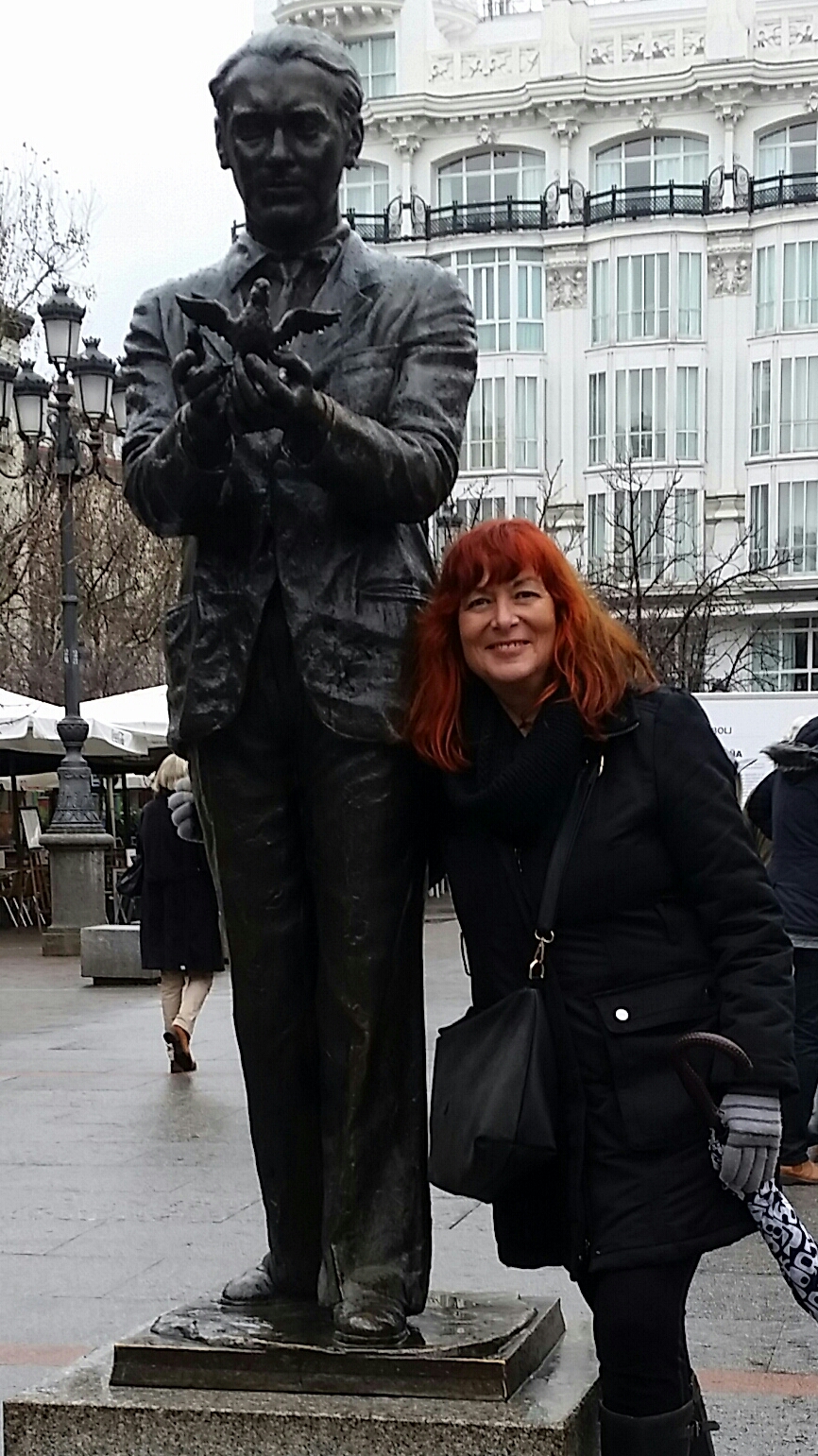
Spanish Golden Age Playwright, Lope de Vega’s house, in MadridSpanish poet and playwright, Federico García Lorca (d. 1936)
Outside the Spanish Parliament.
#FridayBookShare was created by Shelley Wilson for book lovers to share what they’re reading. The idea is to answer a few simple questions about the novel and post on Fridays.
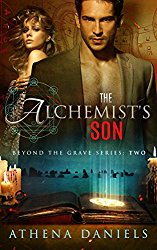
Today, I’d like to share The Seer’s Daughter by Athena Daniels
I found this book quite by chance on Story Cartel and thought I’d give it a go. I’m so glad I did. I thoroughly enjoyed it. By the way it will be there to download in exchange for a review for another eight days!
First line of the book.
Sage Mathews hugged herself as the raging storm flung rain against the windows.
Recruit fans by adding the book blurb.
For her, he’ll break all the rules…
Upon returning to her hometown for her grandmother’s funeral, Sage Matthews is terrorized by a series of strange events. She dismisses each eerie occurrence as a by-product of her overwrought emotional state, until it becomes chillingly clear that something not of this world is desperate to get a message–or is it a warning?–through to her…
Detective Sergeant Ethan Blade comes to Cryton, South Australia, to catch a serial killer. When Ethan meets Sage–the latest victim’s beautiful granddaughter–his attraction to her is explosive and inconvenient. He knows she’s not crazy, but Sage’s theory about the murders is unbelievable.
With the handsome detective rejecting her ideas, Sage embarks on the supernatural journey that her grandmother started. What she discovers shatters everything Sage ever knew about herself–and who she really is.
Ethan’s routine case quickly turns personal when he discovers Sage is the killer’s next target. For her, he’ll break all the rules and cross every line. But how can he protect Sage from an evil he cannot even conceive of?
To save her, he must let go of everything he ever believed.
Introduce the main character using only three words.
Sage is psychic, brave, and determined.
Delightful design (add the cover image of the book).
Audience appeal (who would enjoy reading this book?)
Anyone who likes paranormal, romantic, suspense in a thrilling story set in rural Australia.
Your favourite line/scene.
Sage is psychic and Ethan is a detective who searches for facts and proof, although he trusts his ‘gut instinct’. Sage has to convince him that his gut instinct is not so different to her psychic abilities as he imagines:
“And what about anger, can you touch that?”
“No.”
“Fear, grief, sadness?”
“No, but you’re now talking about feelings.”
“Yes, but if you can trust your feelings, if those are real, even though you cannot see or touch them, it’s not too much of a stretch to say that we can feel other things too. Use the same senses we use unconsciously every day to become aware of more than we’re used to.”
“I suppose so.”He frowned, considering. “But since it’s never happened to me, it’s difficult for me to believe, that’s all.”
“But it does happen to you, Ethan. All the time. You say you rely on your senses for work. You sense when someone is watching you even when you can’t see them. You sense when something is ‘off.’You somehow just know when someone is lying to you or not telling you the whole truth.”
He opened his mouth to refute what she was saying, then closed it again. Could she be right? Was he not the man of hard evidence he’d always believed himself to be? What she said was true. He did rely on those very senses more than the other guys on the force did. That’s why he was so good at his job. Perhaps he had more in common with the ghost buster than he’d thought. His stomach roiled.
“I still think there’s a rational explanation for all of this. How did something without a body cut out black circles of material and place them over empty eye sockets?”
She slumped against him. “I almost thought you were going to understand. Tell me, Mr. Detective Extraordinaire. Give me the oh-so-rational explanation for all of this. And don’t forget to explain how it is that we’re trapped in this car with a dashboard flashing ‘Sage,’my name, Ethan, when I would bet my last dollar that word was never programmed into its computer. And while you’re at it, you might explain why the streetlights are going out one by one.”
He glanced out the window. Sure enough, the whole street was now in a blackout. The sky was clear, the moon bright, and he could still see clearly without the streetlight.
There’s a second book in the series, The Alchemist’s Son, which I’ve already started reading, because although ‘The Seer’s Daughter’ doesn’t end in a cliffhanger, there are some important loose ends, which are tied up in book two.
Happy weekend reading! Check out some of the other reading suggestions on twitter on #FridayBookShare