#BookTour ‘Paradise Prison’ by Faith Mortimer @BrookCottageBks


paradise-prison-tour-banner

Every time a new book by Faith Mortimer is published is a celebration. I’m thrilled to be taking part in this tour for her latest novel, PARADISE PRISON, which has just been released.

Hammerhead shark fin, circling us in cove, Spring Break, St. John Island, US Virgin Islands, 1975


Genre: Psychological Thriller

Release Date: 7th January 2017

Series: Dark Minds #4

Publisher: Topsails Charter

Blurb

Following an almighty row, Gillian stands up to her abusive boyfriend. The consequences are horrendous and far-reaching.

Terrified, she flees her home, seeking anonymity abroad while coming to terms with the outcome of her actions.

In Portugal, Gillian meets Harry, a yachtsman. Needing crew for his Atlantic Ocean-crossing she applies for the job. Half-way into the journey, after confessing to her crime, Harry offers her refuge on an uninhabited island in the Caribbean which he says he owns.

Confused and depressed, Gillian imagines this is the answer to her problems. She needs time to lie low and consider her options; confront the authorities or live in obscurity? Harry is offering the perfect hiding place…or is he?

When things start going horribly wrong, she asks herself if she is alone on the island. But maybe the biggest question of all is why she gets the gut feeling Harry wants to keep her there at all costs?What happens when she says … no.

 BUY LINKS!

AMAZON UK

AMAZON US

faithbook2

ABOUT FAITH MORTIMER

Faith is a British author dividing her time between Hampshire, England & Cyprus. Since 2005 she turned her hobby of writing into a career. During childhood, she dreamed of writing novels which readers would love, & spent many hours writing short stories which she read to her sisters. Born in Manchester & educated in Singapore, Malaya & Hampshire, England. Amazon Top #14 author rank for mystery, #27 mystery, thriller & suspense, #55 literature & fiction #5 bestselling author on Nook Books. Faith’s books have made the Kindle Top 100 Paid List numerous times.

Facebook: https://www.facebook.com/FaithMortimer.Author/

Twitter: https://twitter.com/FaithMortimer

Goodreads Author Page: https://www.goodreads.com/author/show/2967303.Faith_Mortimer

Google+ https://plus.google.com/u/0/105949740968880690288

Website: www.faithmortimerauthor.com


Giveaway!

1st Prize – Ecopies of all 4 books in the series

2nd Prize – an ecopy of the book

Join in here!


Carrot Ranch #FlashFiction Challenge: Strike at the Quarry

This post was written in response to Chari Mills Carrot Ranch weekly 99-word fiction challenge

January 19, 2017 prompt: In 99 words (no more, no less) write a about a quarry. It can be a place or include the by-product. The quarry can be operational, abandoned, it can be in real-tie or mentioned from another time. Where will the quarry take you? Go where the prompt leads.

january-19

Strike at the Quarry

Look at him, the great Sisyphus. Ever wondered where his rocks come from?’

‘Rocks? There’s only one.’

‘One, for all eternity? They get worn down in no time, and he’s got an army to roll ‘em up for him.’

‘Really?’

‘Do you know who does all the work?’ He asked pointing a finger at the pickets.

‘We dug those rocks out of the quarry, carried them for bloody miles, and pushed them up, but he gets all the praise.’

‘What a nerve!’

‘We’re going on strike. No more exploitation of the working classes. Get your own rocks, Sisyphus!’   

****

I’ve gone all the way back in time to Greek mythology for my inspiration this time.

The myth of Sisyphus, the mortal King of Corinth who was punished by the Gods to carry the same rock up and down a hill for all eternity, has always fascinated me.

sisyphus-by-titian-1548-49-prado-musem
Sisyphus by Titian (1548-49) Prado Museum, Madrid, Spain.

Then the great Albert Camus tried to convince me that Sisyphus was happy, because he had accepted his lot. Rebellion leads to unhappiness. Accept that life is harsh and absurd and you’ll be all right. A shocking suggestion for a nonconformist optimist like me, and yet the concept fascinates me because it’s what so many people do without questioning.

camus-quote

Am I doing what I want to do?

Is this the life I want for myself?

If your answer is no, you need to answer so many more questions you may never find the answer to, such as what are the alternatives? How can I achieve them? What if I fail? Will I ever be happy or satisfied? Will I be worse off in the end if I don’t accept my lot? etc.

According to Camus, questioning the harshness and absurdity of life will only lead to greater unhappiness.

However, if your answer is yes, I’ll do as I’m told, your problem is solved. Just get on with pushing the rock up every time it goes down. Don’t think, don’t complain, just do it. Obey.

on-camus-sisyphus

I’ve discovered my own answer.

I’m not following anyone’s rules.

I’m terribly disobedient, disrespectful, and challenging.

I’m not interested in doing what I’m told or even explicitly searching for happiness.

I want to experience life as an ongoing process, a journey which ends in death, and may or may not continue on to other unknown destinations.

And while I’m here, I can’t stop asking: what if?

What if Sisyphus wasn’t punished at all?

What if he craved glory?

What if he needed to be praised and loves carrying the rocks up the hill?

What if he loved showing off his muscles and his strength?

What if others were envious of him and his fame?

What if he got others to do his dirty work?


WRITESPIRATION #99 52 WEEKS IN 52 WORDS WEEK3 #FlashFiction Lost Things

This post was written in response to Sacha Black’s third weekly prompt for 2017 (52 weeks in 52 words).

52-words

Sacha will post one prompt a week for 52 weeks, and the challenge is to write a story in just 52  words exactly. Sounds like a fabulous idea. The value of conciseness for a writer is invaluable, as Sacha herself reminds us: ‘The art of being concise is nothing if not a muscle flexing ‘write’ bicep curling device’.

This week’s prompt is to write about Lost Things. I’m afraid I’ve come up with some sad words this time.

****

Lost Things

‘My keys?’ Beth asked searching frantically.

‘Tried the first drawer, darling?’ James replied with a smile.

‘Of course!’  She kissed him. ‘Why do you always know where everything is?’

‘Magic.’ James lied, wrapping his arms around her.

He held her tightly.

How would they cope when James became yet another nameless face?

****

Alzheimer’s, in any of its many forms, is a cruel disease.

I’ve witnessed its devastating effects in close relatives.

Lost is a word which would identify the feeling.

Patients feel they are living in another world, with other people, unlike anyone they ever knew.

I suppose it’s like taking a step forward and not recognising where you’re going or what you’re seeing, and when you look back there’s nothing there, except a void.

Finally, one day, you look in the mirror, and the only person you were still sure about becomes another stranger, staring back at you.

Devastating for the patients, carers, friends and relatives.


#SilentSunday #Sixwordstories

wp-1485088555579.jpg
Seen last night as I looked out of the window from my writing desk. A fleeting and wonderful moment I managed to capture, for us.


Happy Sunday morning!

Thank you all for being there, inspiring me to read, to write, to think, to plan, to look forward with joy, to look back and reassess, to never give up…

Thank you my friends, followers and likers, those who drop by occasionally and those who are always there.

For those whose eyes I can see and whose hands I can touch.

For those whose minds I can hear and whose thoughts I can feel.

I wish you all back the warmth and inspiration you give me.


#SOCS Of Glass and Pigs

This post was written in response to Linda Hill’s weekly stream of consciousness Saturday prompt

Socs Badge

This week’s prompt for Stream of Consciousness Saturday and Just Jot It January is: “glass.” Use the word “glass,” or find something that’s made of it and use that in your post. Have fun! Here’s my take!

****

Of Glass and Pigs

Glass is a wonderful substance which has plenty of useful purposes.

It allows people with poor eyesight the ability to see better and especially read. Imagine how dreadful it would be not to be able to read! Lenses have also been invaluable in the realm of photography, the cinema and television, at least originally.

Glass also protects us from the cold and allows us to look out of our windows and see the world go by from our homes, cars and other vehicles, behind a safe screen.

Glasses can be filled with wine and other types of beverages. I mean it wouldn’t be the same without it. Imagine drinking chardonnay out of a paper or plastic cup, yuk! OK, I’m sure we’ve all done it at some time in our lives, but honestly, it really doesn’t taste the same, does it?

I remember going to a glass factory in Harrow, north London when I was at school Primary School. There we were shown how glass was made. I’m sure we did a huge project afterwards, and I’m ashamed to say I don’t remember a single thing about how glass is made, except that some kind of sandy product and heat was involved in the process, but I’m not even sure about that. What I do remember are the beautiful colours and shapes of some of the glass objects we were shown.

glass-harrow
Harrow Museum Collection. Wow! Found this after writing the post. Pretty, arent they?

Alas, glass can also have very negative connotations when used metaphorically.

The glass ceiling was originally used (especially in the US) to refer to an invisible or transparent barrier which keeps certain social groups out of mainstream activities or power. The often unvoiced, unspecific or even unspoken prejudices against women, racial and other minorities in general. This theory was especially identified with feminist movements of the 60s and 70s.

According to this theory, these groups were allowed to take part in all levels of social and workplace interaction, but only to a certain level, because the good or top jobs and positions were reserved for the elites or so-called WASPs or white Anglo Saxon protestant men.

We’ve supposedly come a long way since then, and many people will probably argue that this glass ceiling no longer exists. We now live in a democratic and fair society where everyone has equal opportunities.

Well, my opinion is that in our part of the world, the mentioned social groups and minorities have achieved a great deal, but we’re still in process. It’s an ongoing struggle for us, but at least we’ve started our journey.  A look at the news, or a short flight to other hemispheres, will show us that in many parts of the world all people are certainly not equal and do not have the same opportunities.

Orwell’s pig said it all so well in Animal Farm, such a long time ago, in 1945, ‘All animals are equal, but some are more equal than others.’

animal_farm_equal

When will there be a full stop the end instead of a comma in that sentence?

By the way, Animal Farm was rejected by many US and UK publishers, before becoming one the most influential novels in the English language, just saying…

Orwell’s 1984 is one of my favourite 20th century novels. The first time I read it at school, about 1974, 1984 seemed so far away, chronologically and as a possibility, so why does it sometimes seem closer now than it seemed then?

Oh dear, where has glass taken me?

All the way from glasses and lenses to windows and wine, Primary schools outings, feminist literary theory, pigs, and 1984.

Well, enough rambling. Back to work now. I have a novel to finish!

#FridayBookShare ‘The Attic Room’ by @LindaHuber19

I’m joining in Shelley’ Wilsons’s Friday Book Share once again with some suggestions for entertaining books to read for the weekend.

Check out the hashtag #FridayBlogShare on Twitter. You’ll get great ideas for weekend reading.

friday-book-share-banner

I’ve had The Attic Room on my kindle for some time and I’m glad I finally found the time to read it. It’s a psychological thriller and a dark family drama, which keeps you turning the pages till the very end.

First line of the book.

The house was empty without Claire.

 Recruit fans by adding the book blurb.

 A father’s secret… a mother’s lie… a family mystery.

An unexpected phone call – and Nina’s life takes a disturbing twist. Who is John Moore? And how does he know her name?

Nina travels south to see the house she inherited, but sinister letters arrive and she finds herself in the middle of a police investigation. With her identity called into question, Nina uncovers a shocking crime. But what, exactly, happened in the attic room, all those years ago? The answer could lie close to home.

The arrival of her ten-year-old daughter compounds Nina’s problems, but her tormentor strikes before she can react. Searching for the truth about the Moore family puts both Nina and her child into grave danger.

Introduce the main character using only three words.

Nina is a loving and brave, young, single mother.

 Delightful design (add the cover image of the book).

attic-room


Audience appeal (who would enjoy reading this book?)

You’ll enjoy this novel if you like to read psychological thrillers with a UK setting. It’s a fast paced and quick read.   

Your favourite line/scene.

Nina’s mother, Claire, tried to protect her daughter, but shortly after her death, Nina will  discover a dreadful family secret. As a result, her life and her daughter’s will be in danger.

20170120_203001 

Buy link on Amazon.com Amazon UK

****

Want to join in sharing a book you enjoyed?

Anyone can have a go – all you need to do is answer the following questions based on a book you are currently reading/finished reading this week and use the hashtag #FridayBookShare. Grab the banner on Shelley’s blog.

First line of the book.

Recruit fans by adding the book blurb.

Introduce the main character using only three words.

Delightful design (add the cover image of the book).

Audience appeal (who would enjoy reading this book?)

Your favourite line/scene.

Happy Weekend Reading!


Carrot Ranch #FlashFiction Challenge: The Mourner

This post was written in response to Charli Mills’ weekly Flash Fiction Challenge.   

January 12, 2017 prompt: In 99 words (no more, no less) write a story that expresses a strong concern, something to give a crap about. Something that brings out the feeling to stand up. How can you use it to show tension or reveal attitudes?

january-12

The Mourner

The undertaker pointed to the sullen lad. “He looks like a good candidate, Mr. Bumble.”

“Any job requiring silence will suit this hard-working boy, Mr. Sowerberry.”

“No speaking required,” he said, then turned to the pauper. “Just crying, preferably bawling his eyes out.”

“Indeed?”

“He’ll be working as a mourner at children’s funerals.”

“Excellent. We’ll be sorry to see him go, but it’s our duty to help destitute orphans.”

Good riddance, he thought. Nobody gives a crap about any of the blighters.

He’d paid a fiver to get rid of Oliver Twist.

Troublemaker.

How dare he ask for more!

****

Oliver Twist may not be Dickens’ best novel, but it’s my favourite. It’s a novel which is very dear to my heart. I read abridged versions as a child and I’ve read and reread the complete novel many times.

Oliver Twist is Dickens at his rawest, most melodramatic, and outspoken. I can almost hear his pen scratching the paper as he writes and see his head shaking with anger at the injustices remembered and portrayed.

I watched all the film adaptations, my absolute favourite is Carol Reed’s 1968 version. I watched numerous versions as school plays, throughout my school days. Years later I took my children to see Lionel Bart’s unforgettable musical adaptation live at the London Palladium in 1994. Here’s Jonathan Pryce as Fagin.

wp-1484596288701.jpg

****

Oliver Twist was an orphan who spent his early years in a workhouse, until he was found a job away from the other inmates, because he was considered subversive as a result of asking for more gruel.

This is the extract from the scene in Dickens’ Oliver Twist where he asks for more gruel:

****

Child as he was, he was desperate with hunger, and reckless with misery. He rose from the table; and advancing to the master, basin and spoon in hand, said: somewhat alarmed at his own temerity:

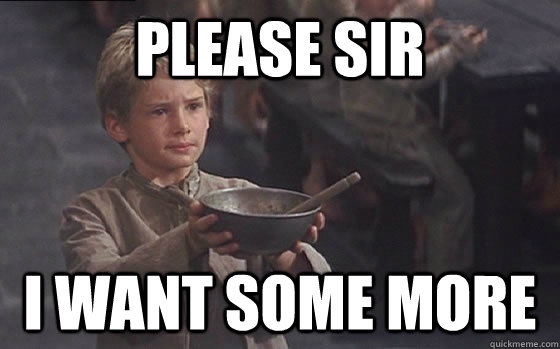
‘Please, sir, I want some more.’

The master was a fat, healthy man; but he turned very pale. He gazed in stupified astonishment on the small rebel for some seconds, and then clung for support to the copper.

The assistants were paralysed with wonder; the boys with fear.

‘What!’ said the master at length, in a faint voice.

‘Please, sir,’ replied Oliver, ‘I want some more.’

The master aimed a blow at Oliver’s head with the ladle; pinioned him in his arm; and shrieked aloud for the beadle.

The board were sitting in solemn conclave, when Mr. Bumble rushed into the room in great excitement, and addressing the gentleman in the high chair, said, ‘Mr. Limbkins, I beg your pardon, sir! Oliver Twist has asked for more!’

There was a general start. Horror was depicted on every countenance.

****

Of course they were horrified, How dare he ask for more? How dare he speak up and challenge injustice? How dare he hope to improve his lot? He was obviously an upstart and it was then that they decided to find him a job away from the workhouse, because he would be a bad influence on the rest of the inmates.

i-want-some-more

Few people gave a crap about children in general, and even less so if they were orphans, in Victorian England.

Child abuse, including child labour, and exploitation, was rampant in Victorian England. Children who survived infancy were often put to work at an early age in textile mills, coal mines, and down chimneys, where working conditions often proved deadly. Girls from the age of five went into domestic service as nurses or maids, and rural children worked on farms, too. Workhouses and poor houses, like the ones in Oliver Twist were cruel places as Dickens himself experienced as a child.

lord_shaftesburycharles-dickens

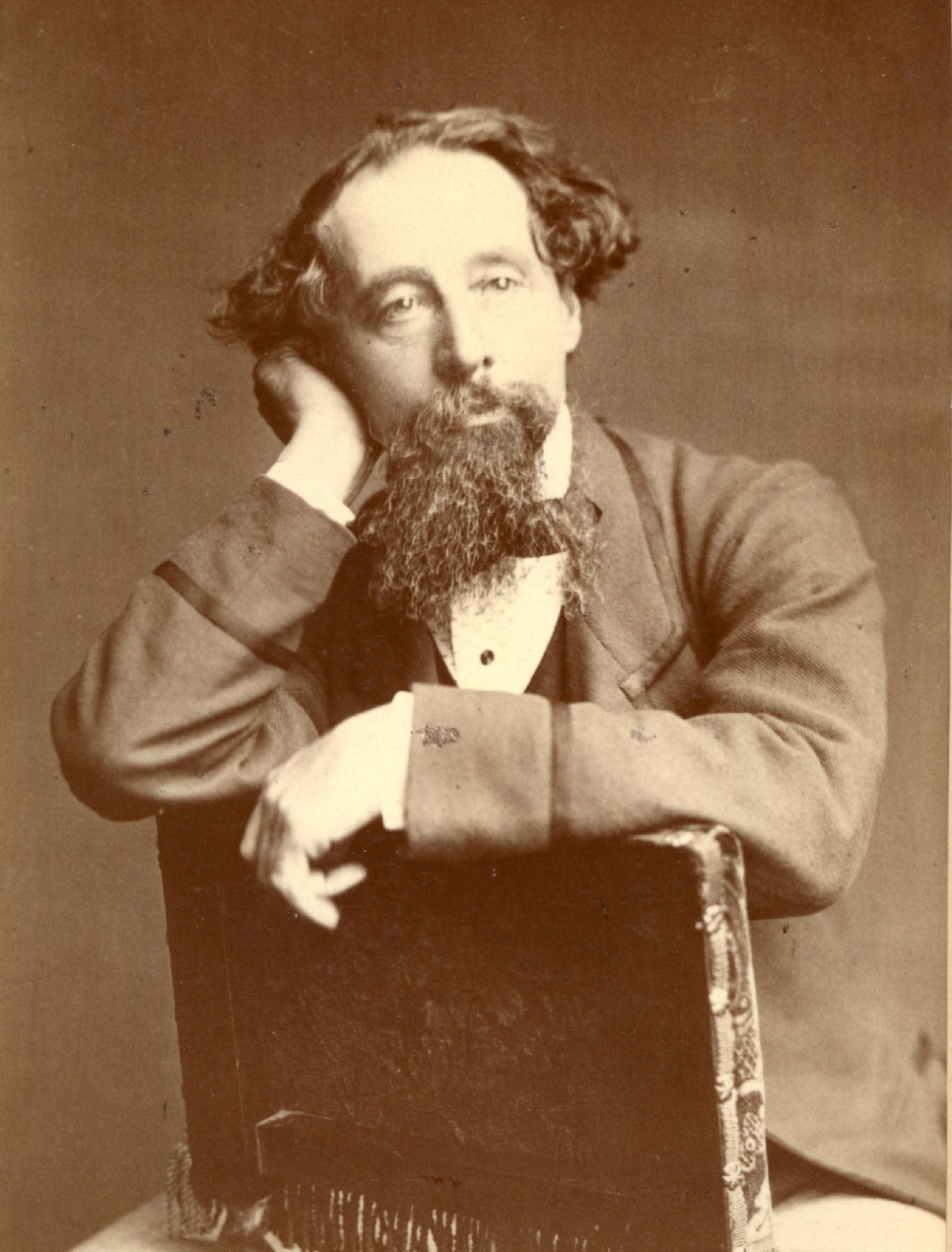
Fortunately, many Victorians campaigned to improve the lives of poor children. Reformers such as Lord Shaftesbury (1801-1885 in the picture above, left), were able to pass laws to protect children from exploitations, such as the 1841 Mines Act which made it illegal for children under the age of 10 to work in a coal mine. The 1847 Ten Hour Act which made it illegal for children to work more than 10 hours in a day. The 1874 Factory Act which banned the employment of children under 10 in factories. Of course if these laws were needed, it meant that children under the age of ten were working as if they were adults, and probably earning a great deal less. Lord Shaftesbury later became the president of the Ragged School Union, an evangelical organization which established hundreds of schools for the poor.

Charles Dickens’ novels revealed and condemned the exploitation of helpless children. When Dickens was twelve, his father was imprisoned for debt and he was sent to work in a blacking factory, an incident that haunted him his whole life. No wonder his novels depict plenty of neglected, exploited, or abused children and orphans.

Oliver Twist (1837) was written to expose and attack on these practices and the cruelty and injustice of workhouses and poor houses for the homeless, which subjected them to unhealthy and inhuman living conditions and hard labour.

800px-olivertwist_front

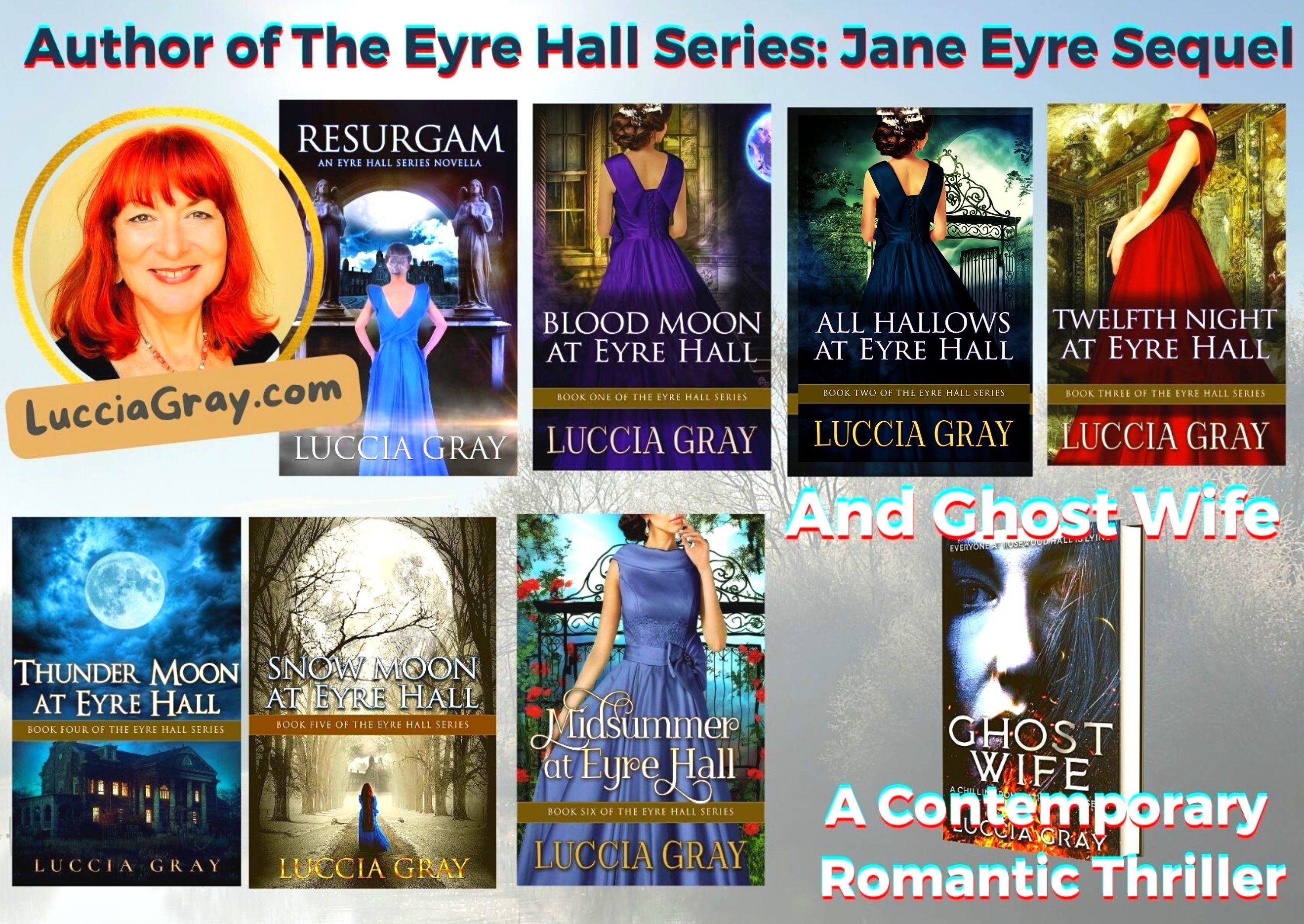
Orphans and their plight also featured predominantly in other Victorian novels, such as my beloved Jane Eyre. Many of the characters in The Eyre Hall Trilogy are orphans or abandoned children, too.

Twelfth Night at Eyre Hall includes an account of a dramatic case of child farming, child abuse and kidnapping, which, as Dickens’ novels, is based on real events.

In the following scene from Chapter XI, Twelfth Night at Eyre Hall. Michael is in London, searching for a child who had been kidnapped and sold. The following is his conversation with a representative of the law, who expresses the general opinion of many people within the establishment, at the time.

****

Sergeant Wilson was a round sort of man. He had a round red–veined face, a large round belly, and fat chubby fingers. I imagined he was a man who enjoyed his food and drink over any other pleasures in life. When he spoke, his slurred and jovial voice convinced me he would never be seen chasing anyone or even organising a chase. I informed him of my suspicion that a woman under an assumed name was buying and selling babies. I was appalled at his lack of interest in the topic.

“There are too many children in London, Lieutenant Kirkpatrick, far too many. They are often born in the wrong families, who cannot feed them or clothe them, so they are taken to other better–off families. It is often a question of social justice. Many of the intermediaries are religious orders. Children are left on church or convent doorsteps, others sadly fall into the hands of dubious individuals such as the one you mention, but in any case, the children who survive will have a better life, don’t you think?”

I could not disclose the real events that had occurred, but I needed to be able to threaten her with some legal action.

“Of course I agree, Sergeant Wilson, but let us suppose a criminal had robbed children and was selling them for immoral reasons, such as prostitution or unpaid labour?”

“If it could be proved in a court of law that she stole the children and sold them, she would be taken to Newgate and later hanged. Unfortunately, none of the parents would miss a hungry baby, and call the police to deal with the crime.”

I tried to convince him that the plight of the babies was important, but he was unmoved.

“Have you any idea how much crime, I mean serious crime, there is in London? Pickpockets, thieves, burglars, and debtors, they are our curse. They threaten the honest, hard–working citizens of London.”

****

Fortunately, at least in Europe, we have a welfare system which caters for the underprivileged, makes education available and compulsory for children up to the age of 16 or 18, a national health service covers all citizens, and there are laws to protect children and other vulnerable citizens, such as immigrants, refugees and the unemployed. We should never forget that this hasn’t always been the case. Social care and civil rights were gained because many people fought for them, and now it’s our turn to make sure they are still guaranteed for our children and grandchildren.

More on the Victorians and child labour at the British Library
WRITESPIRATION #98 52 WEEKS IN 52 WORDS WEEK 2 Badly Timed #Trump

This post was written in response to Sacha Black’s second weekly prompt for 2017. 

52 weeks in 52 words.

52-words

Sacha will post one prompt a week for 52 weeks, and the challenge is to write a story in just 52  words exactly. Sounds like a fabulous idea. The value of conciseness for a writer is invaluable, as Sacha herself reminds us: ‘The art of being concise is nothing if not a muscle flexing ‘write’ bicep curling device’.

This week’s prompt is to write about the badly timed trump!! Oh dear 😦

Here goes my take.

****

‘Heard about Liberty’s new husband?’

‘Tall, dark and handsome, knowing her.’

‘Overweight, blonde, ugly and rude.’

‘But she’s beautiful, generous and kind!’

‘Go figure.’

‘What’s his trump card?’

‘Perhaps she was lonely and depressed.’

‘So he popped up at the right time?’

‘Badly timed, you mean.’

‘Whoever introduced them?’

‘His Russian friends.’

****

liberty


#SOCS Platforms for #Authors

This post was written in response to Linda Hill’s weekly stream of consciousness Saturday prompt

Socs Badge

The Friday prompt for this Saturday is: A word that starts with “P.” Find a word that begins with the letter “p,” and make it the theme of your post. Bonus points for starting and ending your post with a “p” word. Enjoy!

Platforms

Platforms are important places for travellers and authors.

We look for them, rush to them, we wait at them, we pace up and down physically, or perhaps we’re quite still, and it’s just our mind working overtime thinking about where we’re going, whether we’ll arrive on time, who we’ll have to travel with, who we might meet on our journey, why the train is taking so long…

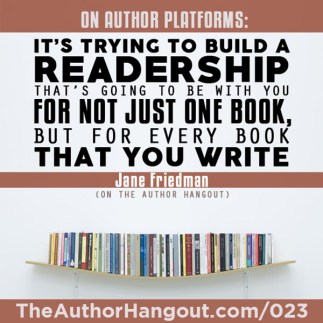
The reason I’ve started this interior monologue with platform is because this morning I just happen to read an article by Jane Friedman about author platforms. In her informative article, she says that, an author platform is ‘an ability to sell books because of who you are or who you can reach.’ Writers are constantly being reminded of how important author platforms are and how writers should build them up even before they start writing.

This means we all need to have a blog, a twitter account, Facebook author page, Goodreads and Amazon author pages, Pinterest boards, Instagram photos, etc. Fortunately, I love social media. I’d been using Facebook and twitter for fun and for sharing information with friends and family long before I started my writing career, so for me it was a case of learning to use it more efficiently for my author purpose. I also need to work more on my platform, including an author newsletter, which I haven’t started yet.

I can imagine how daunting, or even unpleasant, it is for writers who dislike this type of interaction. Perhaps they can survive/be successful without an online author platform, but I seriously doubt it.

Platforms are stages on our journey.

When we’re travelling by train, our destination is a specific place, and once we arrive and leave the platform behind, we can forget about it, until we need to travel again.

Unfortunately, it’s not the same if it’s an author platform, although our platform will hopefully be taking us on our journey to publishing, connecting with readers, selling books, etc. We can’t stop using them once we arrive. Author platforms have to be present in our lives constantly, and we need to update them and interact with others constantly.

This interaction takes up valuable writing  time, and while some writers consider it’s a waste of time, it would be wiser to consider it as an investment, a permanent and ongoing investment, which will accompany us throughout our journey or writing career.

Author platforms are not only important for independent authors. Successful, traditionally published authors like Stephen King, Ken Follett or J. K. Rowling are regular users of their author platforms, too.

So I suggest you spend/invest part of your ‘writing’ time on promoting your author platform, right now!

****

That was stream of consciousness, but I’m adding a few links, including one to the article which sparked me off, in case you’d like more information about author platforms.

Here’s Jane Friedman’s

Charli Mills at Carrot Ranch, the home of Rough Writers, has also written a series of articles on building an author platform.

Remember:

on-author-platforms

#FridayBookShare A Hollow Heart by @AdrienneVaughan

#FridayBookShare was created by Shelley Wilson for book lovers to share what they’re reading. The idea is to answer a few simple questions about the novel and post on Fridays.

Friday Book Share banner

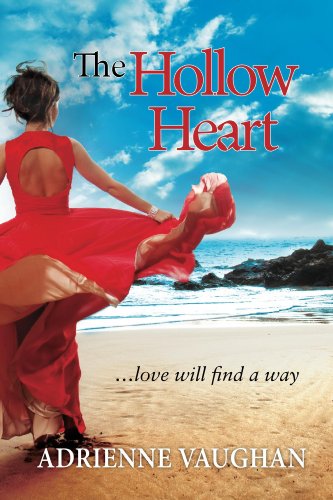
Today, I’d like to share A Hollow Heart by Adrienne Vaughan

First line of the book.

The runner pushed open the office door, a bundle of newspapers gripped tightly under one arm.

Recruit fans by adding the book blurb.

This heartrending mystery thriller is the story of Marianne Coltrane a feisty, award-winning journalist who uncovers a devastating travesty of justice involving the sale of babies by the church in Ireland. Fighting her corner in the male-dominated world of newspapers she witnesses a terrorist attack that changes how she thinks about her future and what she really wants. Taking herself off to the wilds of the west of Ireland to re-evaluate her life, she encounters the soon to be world-famous actor Ryan O’Gorman, to her mind the most conceited, infuriating man in the world. He in turn loathes journalists, especially female ones. One thing they do have in common is they both think their chance of true love has passed them by. As they both begin to fall in love with Innishmahon, their spiritual home, they discover the very fabric of the island is threatened and as the islanders find themselves in grave danger, Marianne and Ryan join forces to save that which they hold most dear. But the road is rocky for this fiery, opinionated pair … and when Ryan discovers his ex-fiance is carrying his child, things take a turn for the worst. Can he talk his way out of this one? And will Marianne even care, when she unwittingly reveals the most devastating secret of all, the truth behind her past and her own parentage.

Sexy, moving and funny, this heart-warming duo and cast of colourful characters will stay with you, long after the last page leaves you smiling.

Introduce the main character using only three words.

Marianne is ambitious, loyal and determined.

Delightful design (add the cover image of the book).


a-hollow-heart

Audience appeal (who would enjoy reading this book?)

Anyone who likes contemporary romance and drama in a story with many twists and turns.

Your favourite line/scene.

After some traumatic events, including her fiancé, George’s unexpected death, and stress at work as a journalist, Marianne decides to move to Ireland for a break. There she runs into Ryan, a famous actor she’d met in England. George and Ryan had been friends in their youth. This short paragraph is taken before she had even thought about leaving England or meeting Ryan again in Ireland.

wp-1484341601878.jpg

There are two more books in the series:

change-of-heartsecrets

And Adrienne has just published a collection of short stories and poems:

fur