#MondayMotivation #The5amClub by Robin Sharma #MondayBlogs #PersonalGrowth

Over the past months I’ve been reading a great number of motivatioal and inspiring books on the topic of personal growth. I’ve also been listening to podcasts and watching videos on YouTube. This interest has sprung from a combination of factors as I’ve recently reached a few significant milestones in my life; I retired and turned sixty and I have five grandchildren between the ages of three months and nine years. I am concerned with aging, health, and emotional wellbeing, as well as my children and grandchildren’s future challenges. I have more time to reflect and more things to reflect on, so I’ve found these books, podcasts and videos very helpful, especially in these uncertain and volatile times in which nothing can be taken for granted. I’ll be sharing my thoughts with you on Mondays.

This Monday I’m feauring a book called The 5am Club: Own Your Morning, Elevate Your Life, another useful book about taking control of your mornings from the moment we wake up and making the rest of that as good as it can be.

The first thing I have to say is that I read the book some months ago with no intention of getting up at 5am, beacuse I’m fortunate enough to be retired and my own boss, so I own my whole day.

I do help with my grandchildren regularly, but I don’t have the responsibility of looking look after a family. Also, I’m retired from my previous salaried employment, as a teacher and professor, and although I’m a writer, which means I write for several hours every day, I don’t have a strict timetable, and I love reading late at night, so 5am doesn’t work for me, at the moment.

You may wonder why I read this book and if I found it helpful. Well, I read it because I wanted to reaffirm and improve my morning routine, which we all have, even if we don’ call it that or verbalise it specifically. This book has helped me do just that; Understand the value of having a morning routine and making sure the three key aspects Robin Sharma talks about, activating mind, body and soul, are consciously inbedded, in some way, throughout my morning.

By the way, I’ll be telling you all about my morning routine, next week!

The 5 AM Club: Own Your Morning. Elevate Your Life. by [Robin Sharma]

Leadership and elite performance expert Robin Sharma introduced The 5am Club concept over twenty years ago, based on a revolutionary morning routine that has helped his clients maximize their productivity, activate their best health, and bulletproof their serenity in this age of overwhelming complexity.

Robin Sharma explains, by means of ample examples and through a dialogue between  a tycoon and his menor, how the habit of early-rising has helped so many successful people accomplish epic results while upgrading their happiness, helpfulness and feelings of aliveness.

He proposes a formula to wake up early feeling inspired, full of energy and focused. One of the key concepts  is that getting up while everyone is sleeping gives us precious time to think, express our creativity and begin the day peacefully instead of running around in a mad rush to keep up with life’s demands and transform our lives.
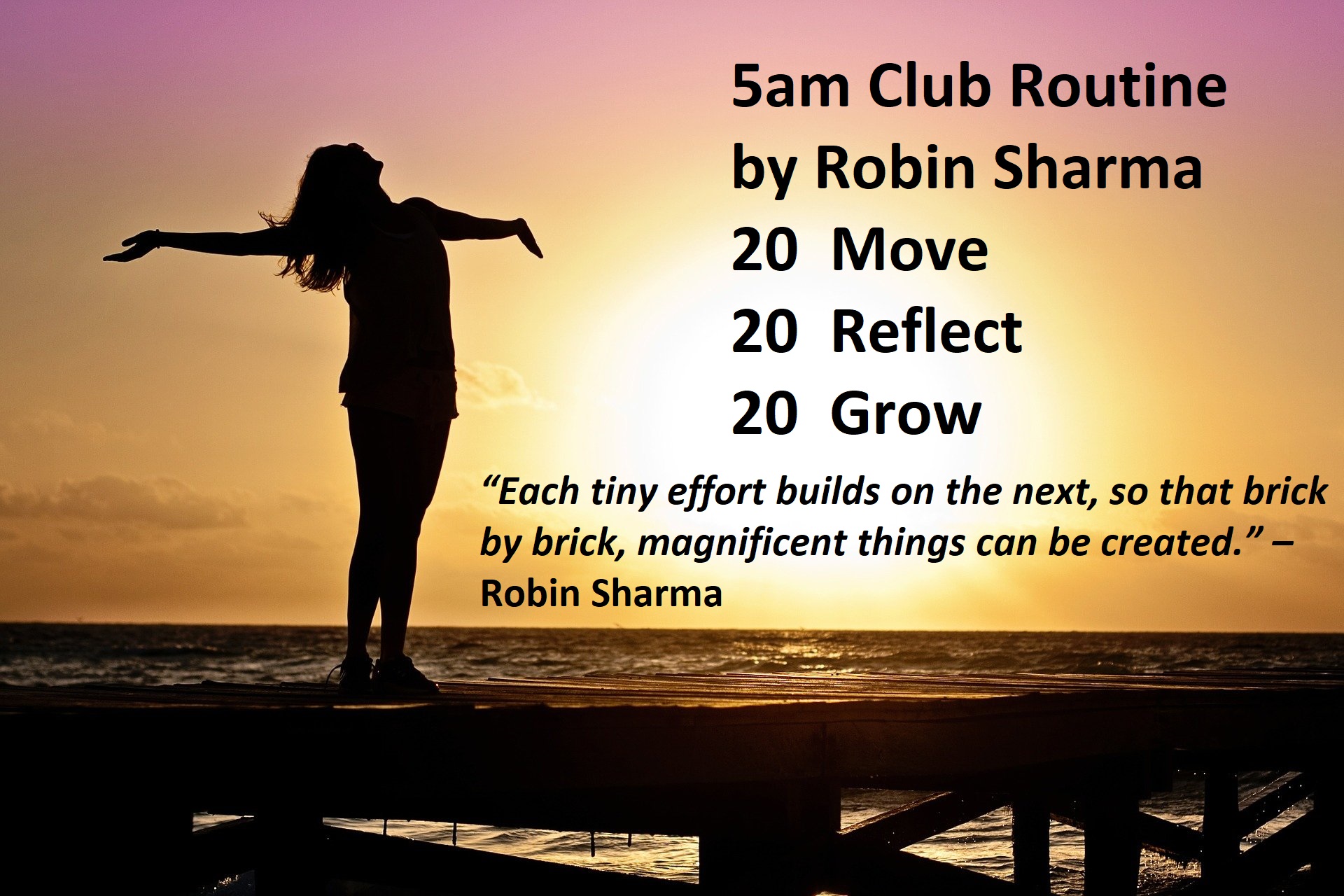
 

The most practical and well-known part of the book, is his 20/20/20 rule. He suggests we reserve the first 60 minutes of our day for personal preparation.

The first 20 minutes should be spent doing intense exercise, because sweating releases BDNF, a brain chemical that grows neural connections. Working out also releases dopamine (the neurotransmitter of motivation) and serotonin, which makes you feel happy.

The second 20 minutes should be spent reflecting on our long term annual plans and goals. This can be done by journaling, meditation, etc. Because this will deepen our focus throughout the day.

The final 20 minutes of our mornings should be spent learning something, reading, or listening to a podcast, basically feeding our minds.

Robin Sharma has plenty of material on his blog where you can learn more about his proposals.

He also has a great YouTube channel where you can listen to him tell you all about how to make the most of your morning, improve your well-being and be successful in whatever you do.

I like the idea of tending to you body, soul and mind, every day, at the start of the day, before you begin your ‘real’ daily demands of life and work, and I think it’s great for busy people. I can see how this routine could help a certain type of young, very active and ambitious person.

However, I’m in a different stage of my life, and although I make sure I’m actively and consciously tending to my mind, body and soul every single day, I don’t think I have to do it at 5am, or in that order, or even all at once.

Do you think waking up at 5am would work for you?

Here’s the link if you’d like to read my other posts on #PersonalGrowth

#Tuesdaybookblog ‘This Time Next Year’ by Sophie Cousens #BookReview #RomanticComedy

Today I’m reviewing another romantic comedy, This Time Next Year by Sophie Cousens, which has been hailed as ‘2020’s most perfect pick-me-up. Refreshingly romantic and certain to hold a special place in your heart.’ It is set in London, mostly on and around 2020 New Year’s Celebrations.

From the Blurb

Quinn and Minnie are born on New Year’s Eve, in the same hospital, one minute apart.
Their lives may begin together, but their worlds couldn’t be more different.
Thirty years later they find themselves together again in the same place, at the same time.
What if fate is trying to bring them together?
Maybe it’s time to take a chance on love…

****

My Review

This Time Next Year, is an uplifting and engaging, quick and fun novel, which I read in one sitting. It reminded me of One Day by David Nicholls, but it’s a much shorter and less intense version of a love story, and it has a happy ending.

The plot revolves around Quinn and Minnie’s meeting on New Year’s Eve, 2019 and ends on the same day in 2020. in between we get flashbacks to previous New Year’s Eves, when they almost met, and various meetings throughout 2020, told mainly from both protagonists points of view, in third person.

It is a slow burn, sweet love story, which gradually unfolds as Quinn and Minnie come face with their emotional issues, and work towards overcoming them. They are both likeable characters, trying to grow emotionally, and the way their relationship develops is believable and sweet. There are also plenty of laugh out loud moments, as well as challenging moments, in their relationship.

I also enjoyed reading about Quinn and Minnie’s parents, who had met when Quinn and Minnie were born, as they shared a room at the hospital. Thirty years later, Minnie’s parents and Quinn’s mother re-established contact and something very special happens (no spoilers, you’ll have to read it to find out!).

The setting, in London, and mostly in the upcoming festive season, was another engaging aspect. It’s definitely worth reading on a cosy, winter afternoon-evening.

#MondayMotivation #TheMiracleMorning by Hal Elrod #MondayBlogs #PersonalGrowth

Over the past months I’ve been reading a great number of motivational and inspiring books on the topic of personal growth. I’ve also been listening to podcasts and watching videos on YouTube. This interest has sprung from a combination of factors as I’ve recently reached a few significant milestones in my life; I retired and turned sixty and I have five grandchildren between the ages of three months and nine years. I am concerned with aging, health, and emotional wellbeing, as well as my children and grandchildren’s future challenges. I have more time to reflect and more things to reflect on, so I’ve found these books, podcasts and videos very helpful, especially in these uncertain and volatile times in which nothing can be taken for granted. I’ll be sharing my thoughts with you on Mondays.

This Monday I’m feauring a powerful little book called The Miracle Morning, or the not so obvious secret guaranteed to transmorm your life before 8am, because every morning is a miracle, and grasping that miracle from the moment we wake up is a life-changing experience.

The Miracle Morning has been translated into 27 languages, and it has almost 5,000 five-star Amazon reviews. It was published in 2012 and is still on the bestseller lists.

For the first sixty years of my life I never consciously thought about my mornings as the key to improving my life, I just got on with them as best as I could. Of course I had a regular routine; I got up, showered, washed my hair, blow dried it, had breakfast, got dressed, put on my make up, and rushed to work, in about forty minutes, every single day.

There was some planning involved the night before. I prepared my briefcase and my clothes for the following day, and as I’m a great fan of lists, I wrote out the following day’s to do list.

So obviously I had a routine which worked for me, but this plan had  no intention of fulfilling my dreams or improving my life. It was something I did to get through the morning as smoothly and efficiently as possible, because I needed to get to work with a clear mind, in the shortest possible time, with as little stress as possible.

Since I retired, my life is my own, and one of the aspects I’m now proud to own, are my mornings. So, I’ve listened to the experts, who all have diverse, but complementary views of what a morning rutine should be, and how these routines can help us to live better, fuller lives and accomplish our dreams. The best book on morning routines is definitely The Miracle Morning.

But before I tell you more about his proposals, I’d like to tell you more about the author, Hal Elrod.

Hal Elrod claims he is on a mission to elevate the consciousness of humanity, one morning at a time. He is a bestselling author of ten books, including one of the highest rated, best-selling books in the world, The Miracle Morning—which has been translated into 27 languages, has almost 5,000 five-star Amazon reviews and his method is practiced daily by thousands of people in over 70 countries.

It was published in 2012 and is still on the bestseller lists.

Hal died at age 20, when he was hit by a drunk driver at 70 miles per hour. His heart stopped for 6 minutes, but he eventually woke from a coma to be told by doctors that he would never walk again. Not only did Hal walk, he went on to run a (52 mile) ultra-marathon and become a hall of fame business achiever—before the age of 30.

However his physical challenges didn’t end there, in November of 2016, Hal nearly died again. He was diagnosed with a very rare, very aggressive form of cancer (acute lymphoblastic leukemia), which he also overcame and Hal is now cancer-free.

He is the Executive Producer of The Miracle Morning Movie—a documentary that both shows you the morning rituals of some of the world’s most successful people, as well as takes you around the world to show you the life-changing impact that Miracle Mornings are having, globally.

Hal is also host of the highly acclaimed Achieve Your Goals podcast, creator of the Best Year Ever Blueprint Live Experience, and bestselling author of ten [10] books in The Miracle Morning book series.

He is also an engaging and talented speaker as you will find out if you watch his talks and interviews. Such as this interview with Tom Bilyeu, co-founder and host of Impact Theory, a series of interviews aimed to expand people’s vision of wellness, which encompasses body and mind, in order to help people develop the skills they will need to improve themselves and the world.

I found Hal’s recipe for happiness and success in the face of adversity a real eye-opener.

ACCEPTANCE. What cannot be changed must be accepted. The key here is to determine when you’re being complacent and when you’re being realistic. That’s a tough decision, and it’s up to each one of us.

ASSUMING RESPONSIBILITY. Once the situation is accepted as inevitable, you have to assume responsibility. You are not a passive observer, there is always something you can do in your new situation or circumstances. Be aware of the power in your hands.

TAKING ACTION. You have accpeted the event and are aware of your responsibility, so now you have to take positive action.

The Miracle Morning: Practical Suggestions

Hal identifies six life savers in the book, namely:

Silence, which can include meditation, prayer, reflection, deep breathing and/or gratitude.

Affirmations. These positive statements harness the power of positive thinking by repetition of previously prepared statements.

Visualisation, which he also calls creative visualization or mental rehearsal, that is using your imagination to create mental pictures of expected outcomes occurring in your life.

Exercise, which will boost your energy levels and your health, improve self-confidence and emotional well-being, enabling you to feel better and concentrate for longer.

Reading. You should read something which will increase your self-awareness and lead to personal growth for at least ten minutes every morning.

Scribbling or journaling, which means writing a diary or your thoughts or ideas.

The book also has plenty of practical tips to actually get up and follow this routine do these ‘Savers’, such as ‘The 5-Step Snooze-Proof Wake Up Strategy’ for people who have a hard time getting up early, or ‘The 6-Minute Miracle (For The Busy People)’ where the whole routine is drastically reduced, from about an hour to 6 minutes.

The Morning Miracle really is a clear, simple and comprehensive book about how to empower yourself by taking a conscious and active control of your mind and body first thing in the morning, and believe me, it works.

Another important thing Hans tells us, is that his book isn’t written in stone, and we should customise his proposals. We all have different lifestyles and needs, and these ‘Savers’ are pointers we should follow and adapt as we go along, in order to achieve our most significant goals, faster than ever before.

Bearing this is mind, over the past months I’ve created my own, adapted version and created my miracle morning, which I’ll be sharing with you next week.

Take care and stay safe.

Here’s the link if you’d like to read my other posts on #PersonalGrowth
#Tuesdaybookblog ‘New Orleans Rush’ by Kelly Siskind #BookReview #RomanticComedy

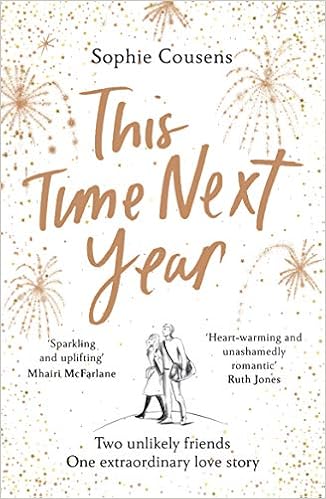
Today I’m reviewing a unique romance I read a few months ago,  New Orleans Rush by Kelly Siskind. It’s the first in a four-book series called Showmen, because the Marvelous Marlow Brothers, the main characters, are theatre entrepreneurs who put on magic shows. Today, I have the pleasure of introducing you to the first of four standalone, romantic comedies with a difference.

My Review

Beatrice Baker meets Huxley Marlow after ‘accidentally’ vandalising his Mustang, which she mistakes for her ex-boyfriend’s, the man who stole all her money. As she is unable to pay for the cost of the repair she agrees to cover her debt by working for the gruff, moody and eccentric magician, at his nightclub, and although she feels attracted to him at once, she isn’t going to fall for a man ever again, of course we know that’s not true and (very) eventually they fall in love.

You know what happens, when you read romantic comedies and they are so alike that it feels as if you’re reading the same novel all over again, and you get bored with the whining or indicisive heroine and brooding or selfish hero? Well I have news for you, this romance is a hundred percent unique!

I love reading romantic comedies, with engaging main and supporting characters, including some suspense, lots of fun and  guaranteed happy ever afters, although I appreciate a few storms along the way, too! If that’s the type of novel you enjoy, New Orleans Rush fits the bill.

When I read the first scene in which they meet, which is alternately dramatic and hilarious, I knew I’d love reading about the two main characters.

But it is not all fun and games. The plot revolves around both their emotional and financial problems, which are plentiful, and some are quite serious. The way they help each other work through their issues and gradually fall in love, was one of the best aspects of the novel.

There was plenty of mostly contained chemistry between the charatcers, which makes a light romance all that much more suspenseful. The setting, in the magical city of New Orleans. and the theatre. where most of the action takes place, added to my interest.

I loved it all, the writing, the story, the characters, the twists, the ending, in fact I was upset when I finished reading, because original and engaging romances are not so easy to find.

Do you have any recommendations for romantic comedies?


#MondayMotivation #Emotional Agility by Susan David #MondayBlogs #Resilience #PersonalGrowth

Over the past months I’ve been reading a great number of motivational and inspiring books on the topic of personal growth. I’ve also been listening to podcasts and watching videos on YouTube. This interest has sprung from a combination of factors as I’ve recently reached a few significant milestones in my life; I retired and turned sixty and I have five grandchildren between the ages of three months and nine years. I am concerned with aging, health, and emotional wellbeing, as well as my children and grandchildren’s future challenges. I have more time to reflect and more things to reflect on, so I’ve found these books, podcasts and videos very helpful, especially in these uncertain and volatile times in which nothing can be taken for granted. I’ll be sharing my thoughts with you on Mondays.


This Monday I’m introducing you to Susan David, Harvard Medical School psychologist and author of #1 Wall Street Journal bestselling book, Emotional Agility. I had seen her Ted Talk some time ago, but more recently I noticed her presence on YouTube and watched some of her interviews, especially one with Ed Mylett.

Her definition of Emotional Agility is a critical skillset that helps us make real changes in our lives. It is the key to thriving.

Emotional agility is heavily influenced by Victor Frankl, survivor of a Nazi death camp and author of Man’s Search for Meaning, in which he states:
“Between stimulus and response there is a space. In that space is our power to choose our response. In our response lies our growth and freedom.”

As I understand her concept of emotional agility, it refers to embracing the bad as well as the good in life and not pretending everything is always fine.

The search of happiness need not be our only goal, because that makes us unhappy; it’s rather to build strength in our core values and embrace and overcome hardship. We should search for strength within ourselves to look inward and live intentionally by working with, as opposed to against, our own emotions. I love this quote:

Here’s Ed Mylett’s interview in which she expands on her theories.

She does not give us an easy recipe for success and the book ends with a series of recommendations I’ve summarised here.

Her advice is to take ownership of our own development, career, creative spirit, work and connections, and to accept the good with the bad with compassion, courage and curiosity.

We should embrace our evolving identity and accept that that being alive means sometimes getting hurt, failing, being stressed and making mistakes, so we should abandon ideas of perfection and enjoy the process of loving and living.

We should abandon the idea of being fearless, and instead walk directly into our fears, because courage is facing our fears instead of ignoring, or avoiding them.

She reminds us that life’s beauty is inseparable from its fragility. Nothing is permanent because we will all age and eventually die and be separated from our loved ones.

Her two final pieces of advice are to, ‘Learn how to hear the heartbeat of your own Why and remember to ‘dance if you can’.

I found her suggestions valuable but theoretical. But I urge you to listen to her interviews and talks which are much more practical.

By the way, if you want to know your level of emotional agility, take her quiz here.

It’s fun and interesting. I found out among other things that I have a very good sense of what my values are and what is important to me, and that I am mostly able to bring these in a real way to my daily life.

I guess that means my introspection, reading and experience are serving me, so far, but it’s an ongoing process…

****

Here’s the link if you’d like to read my other posts on #PersonalGrowth

#SundayWalks #Autumn in the Park #November

Autumn un the parkNovember morning sunraysBursting through turquoise skyShadows stretch across the lawnOf crunching russet leavesAll is calm, for now.


#MarcosPlaylist ‘Just the Two of Us’ sung by Grover Washington, Bill Withers and Will Smith #Saturdaysingalong #Tanka #Spotify

Welcome back to #MarcosPlaylist and #SaturdaySingalong with another song from the playlist I made for my grandson in August 2020 on Spotify, when he was just a few days old. I chose my favourite songs with a mellow rhythm to sing to him, dance with him cradled in my arms and perhaps send him to sleep, or at least calm him down! This post, tanka and playlist is for Marcos, now sixteen-weeks old.

Today I’m featuring “Just the Two of Us“, a beautiful song with spellbinding lyrics and an unforgettable melody, written by the great Bill Withers, William Salter and Ralph MacDonald. It has been sung by many artists, but the most memorable are Grover Washington Jr. and Bill Withers.

It was first recorded by Grover Washington Jr. on the album, Winelight (1980). An edited version reached number 2 on the US Billboard Hot 100, The song won a Grammy Award for Best R&B Song. 

Bill Withers included the edited version on the 1981 compilation Bill Withers’ Greatest Hits and many subsequent greatest hits collections. The following youtube video has over 33 million views!

Seventeen years after its first recording, Will Smith released a single in 1997 which includes some of the lyrics and his own interpretation, which focuses on the relationship between a father and son. It is performed it in rap.

I’m pleased to know I’m not the only person who thought of their son or grandson when they heard and sang the song!

Will Smith also wrote a children’s book with the same title and lyrics (I’ve checked and it’s out of print).

Today’s #Tanka for Marcos

Just the Two of Us

Spending time with you
Is like a crystal rainbow
Lighting up the sky,
Made of magic raindrops falling,
When the sun comes shining through.
****

Marcos was just a week old in this picture!

#TuesdayBookBlog ‘The Tenant of Wildfell Hall’ by Anne Bronte #BookReview #Victorian @Audible #Audiobooks

I read The Tenant of Wildfell Hall too many years ago, in my teens, when I read all the Bronte sisters’ novels, but I just couldn’t for the life of me remember much about the story. So, as the version I read, narrated by  Alex Jennings and Jenny Agutter was on Audible Included, which means that as a member, I could listen for free, I decided to have a go at the audio version. I wasn’t surprised when I was hooked immediately, I’ll tell you why right away.  

The Tenant of Wildfell Hall Audiobook By Anne Brontë cover art

From the Blurb

Fleeing a disastrous marriage, Helen Huntingdon retreats to the desolate mansion, Wildfell Hall, with her son, Arthur. There, she makes her living as a painter. Finding it difficult to avoid her neighbors, she is soon an object of speculation and gossip. Brontë portrays Helen’s eloquent struggle for independence at a time when society defined a married woman as her husband’s property.

Before I start my review, I’d like to tell you why I love Audible. I know I’ve told you many times already, but it’s even better now! My monthly credit allows me to buy one audiobook of my choice every month, plus there are daily deals and frequent sales and two for the price of one offers, plus there are loads of free listens in the ‘Included’ catalogue, which has new additions every week, and there are podcasts.

And I love to listen to audiobooks while I work out, go for walks, do the cooking, the laundry, the cleaning, clearing out cubboards, and much more! Here’s more information, in case you’re interested. (By the way, I have no commercial affiliation to Audible, I just wanted to share how great I think it is!) 

My Review

The Tenant of Wildfell Hall was easy for me to enjoy. You all know how much I love Victorian Fiction, and as I had completely forgotten about the plot, it was like reading it for the first time. 

It’s a very long, three volume novel, as was the custom of the time. It is over 800 pages and over16 hours of narration time. The Tenant of Wildfell Hall is the second and final novel by Anne Brontë, the youngest of the Bronte sisters. Her first novel was Agnes Grey, which I only vaguely remember, so I’ll probably be reading it again, soon, too.

The Tenant of Wildfell Hall was first published in 1848 under the pseudonym of Acton Bell. Although it was very successsful, it was considered the most shocking of the Brontë’s novels, and I can’t imagine why, because the main female character, Helen, is so very pious that she is at times quite nausiating. In fact, I was often furious with her subservient behaviour, especially in the third part of the novel, but more about that in a moment.

The first volume is narrated by Gilbert Markham (by the way, one of my new favourite romance heroes!), who is telling his friend about how he came to meet the Tenant of Wildfell Hall. He was intrigued and fascinated by Helen Graham, a beautiful and aloof, young widow, who moved into the crumbling, old Hall, with her young son, Arthur. They do eventually (very eventually), become friends, but then she becomes the target of local gossip and it is discovered that she is not a widow, because her husband is alive.

The second volume is narrated by Helen, who gives Gilbert all the letters she wrote from when she met her husband to the moment she left him. Here she shows herself to be a devoted wife, who is in love with an unworthy husband, and although she put up with a lot of psychlogical and some physical abuse, she was finally strong-willed and determined enough to abandon him.

This part of the novel certainly gives us a clear insight to the life of the country gentry and servants of the era, as well as the submission of women, even wealthy women, to their husbands,  fathers and religious notions of women’s piety.  I both pitied and admired Helen at this point, because I thought I was going to read a 19th century, #MeToo novel, and I almost did, but as I read the third part I discovered I was wrong. 

This third part, narrated by Gilbert, describes how she returned to her husband and what happens afterwards, but I won’t spoil it for you by telling you how the ending comes about. I will tell you I was exasperated with both Gilbert and Helen, and her brother, but especially with Helen, for being so obstinate and submissive. So, although I did enjoy the ending, I found it was not the feminist novel I had been expecting to read.   

A modern editor would have reduced the novel by half, even I, lover of Victorian literature, was impatient for something to happen and maddened by the going round in circles of the same events, and long drawn out conversations, which did not move the plot forward a single inch! 

There are two major difficulties in reading this type of Victorian fiction, for the modern reader; in the first place the excessive length, verbosity and repetition of certain parts, and on the other hand, the cultural and emotional distance, with contemporary readers. The later makes it hard to understand or sympathize with their passive acceptance of patriarchy, gender differences and medieval attitude to religion, and the former can become frustrating.  

However, there was one aspects that reminded me of contemporary society; harmful and spiteful gossip and blatant lies, which still occurs today, except nowadays it would spread on social media, instead parlours and at sunday service.   

I would recommend the audio version, because it brings the characters and events to life and makes the tedious parts more enjoyable (and you can speed them up!).

I hope I haven’t put you off, because it really is worth reading. The prose flows smoothly and the vocabulary and expressions are gorgeous, and you will be rewarded with an authentic, first-hand glimpse of what life was really like for women, men and children, in Victorian England. 

Have you read The Tenant of Wildfell Hall? What was your impression?


#MondayMotivation #Maxout your Life by Ed Mylatt #MondayBlogs #Health #PersonalGrowth

Over the past months I’ve been reading a great number of motivational and inspiring books on the topic of personal growth. I’ve also been listening to podcasts and watching videos on YouTube. This interest has sprung from a combination of factors as I’ve recently reached a few significant milestones in my life; I retired and turned sixty and I have five grandchildren between the ages of three months and nine years. I am concerned with aging, health, and emotional wellbeing, as well as my children and grandchildren’s future challenges. I have more time to reflect and more things to reflect on, so I’ve found these books, podcasts and videos very helpful, especially in these uncertain and volatile times in which nothing can be taken for granted. I’ll be sharing my thoughts with you on Mondays.

This Monday I’m introducing you to Ed Mylett, Life strategist, entrepreneur, fitness enthusiast, motivational speaker and author of #Maxout Your Life.

I came across his YouTube channel, because he regularly interviews other motivational speakers ranging from neuroscientists to influencers and authors, on topics such as ageing, fitness and mental health, as well as giving his own short, motivational tips on how to reach your goals by focusing, creating positive thoughts and believing in yourself.

Here’s his recent interview with Susan David, psychologist at Harvard Medical School and author  of Emotional Agility: Get Unstuck, Embrace Change and Thrive in Work and Life.

He insists that ‘Others don’t control you. Don’t let them be your dream killers,” and encourages us to empower ourselves and hold ourselves responsible for our achievenents, which are temporary gains, and losses, which are opportunities for improvement. ‘You are not an extra in your life, you’re the main character, you write the script.’ is another of his quotes. Building self-confidence is one of his main themes.

He’s also keen to convince us that physical fitness is as important as mental focus, so there’s a lot of advice on creating positive habits related to exercise and diet, and morning and evening routines.

#Maxout Your Life Audiobook By Ed Mylett cover art

I listened to his book, #Maxout Your Life on Audible, which has the added bonus of being narrated by the author himself. It is a tiny gem of a book which presents all his advice and philosophy in a concise nutshell. It did leave me wanting more, but on the other hand, I was grateful that every word was motivational worth listening to.

Here’s one of his recent Twitter posts.

He is rather forceful at times, compared to speakers like Marisa Peer or Deepak Chopra, who have previously been featured on my blog, but now and again it’s a good idea to listen to someone who ‘shakes some sense (or good ideas) into you’!

Here’s the link if you’d like to read my other posts on #PersonalGrowth