I went to Amazon, which I where I buy all my books.
2) Randomly choose a category
I didn’t know where to look, Amazon is so vast. When I go I’m usually referred to by another author, twitter, facebook. I mean, I don’t just go and look for a book as I would in a ‘real’ bookshop.
There I was wondering what to type, when I went into my last purchase and saw a little star which said best books of the month.
I had a quick look and they were all very expensive for an ebook, more than $8, and I already have a huge TBR list.
3) Speed through the book covers, choose one which has instantly appealed to your eye.
I sped through the covers and I saw Sue Monk Kid’s Novel The Invention of Wings for $1.00!
I remembered that she had written The Secret Life of Bees, which I thought was a fascinating book, so I chose it at once.
4) Read the book Bio/ Description for this book.
So I went to the book’s page and read the blurb.
Inspired by the true story of early-nineteenth-century abolitionist and suffragist Sarah Grimké, Kidd paints a moving portrait of two women inextricably linked by the horrors of slavery.
A powerful, sweeping novel, inspired by real events, and set in the American Deep South in the nineteenth century, THE INVENTION OF WINGS evokes a world of shocking contrasts, of beauty and ugliness, of righteous people living daily with cruelty they fail to recognise; and celebrates the power of friendship and sisterhood against all the odds.
5) If there are reviews, check out a couple.
Then I saw the number of reviews and stars and was in awe, I mean that number of readers can’t be wrong, can they? 9,972 customer reviews 4.6 out of 5 stars. I read some of the reviews and marveled at how quick and lucky I had been to fnd such a great book at such a good price so quickly!
6) Make an instant decision, would you BUY or PASS?
Buy, buy, buy!
That was easy! Now I just need to find time to read, that’s the hard part for me!
My Friday Five Challenge is this….. IN ONLY FIVE MINUTES….
1) Go to any online book supplier,
2) Randomly choose a category,
3) Speed through the book covers, choose one which has instantly appealed to your eye,
4) Read the book Bio/ Description for this book,
5) If there are reviews, check out a couple,
6) Make an instant decision, would you BUY or PASS?
(then write a little analysis about your decision)
The moon makes many symbolic and significant appearances at Thornfield Hall, so this post will also come in two parts. This first part refers to Jane’s arrival at Thornfield hall and her first encounters with Mr. Rochester. The rest of her stay at Thornfield Hall will be covered in The Moon in Jane Eyre Part Three.
The Third Storey and The Attic at Thornfield Hall
The moon makes its first appearance the day after Jane’s arrival at Thornfield Hall. In the evening, once her first class with Adele was over, Mrs. Fairfax offered to show her around the house. The tour ended in the mysterious and uncanny third storey, which was devoid of the moonlight:
All these relics gave to the third storey of Thornfield Hall the aspect of a home of the past: a shrine of memory. I liked the hush, the gloom, the quaintness of these retreats in the day; but I by no means coveted a night’s repose on one of those wide and heavy beds: shut in, some of them, with doors of oak; shaded, others, with wrought old English hangings crusted with thick work, portraying effigies of strange flowers, and stranger birds, and strangest human beings,— all which would have looked strange, indeed, by the pallid gleam of moonlight. If there were a ghost at Thornfield Hall, this would be its haunt.’ ‘So I think: you have no ghost, then?’ ‘None that I ever heard of,’ returned Mrs. Fairfax, smiling. ‘Nor any traditions of one? no legends or ghost stories?’ ‘I believe not.”
Jane and Mrs. Fairfax continue their tour to the attic, which Jane describes as black as a vault. They walk up a very narrow staircase and then with the help of a ladder through a trap-door to the roof of the hall and a view of the surrounding countryside, which Bertha is denied.
Bertha’s room was described as ‘windowless’ and the rest of the upper floor was dark and gloomy, probably due to small windows and heavy curtains. The moon, which has been a positive omen in Jane’s life, lighting her way in dark moments, and announcing the appearance of positive characters, is denied to Bertha who must live concealed in absolute darkness.
Notice also the lies Mrs. Fairfax tells Jane when she claims there are no legends of ghosts, yet all the servants are aware of Grace Poole’s secret charge in the attic and the strange noises, which they all hear on occasions.
The lack of moon in this instance indicates a moral as well as physical darkness, as it encloses falsehood, as well as captivity and concealment.
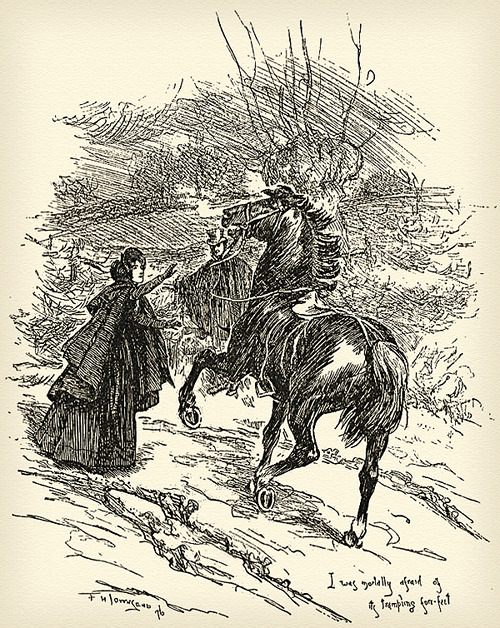
Illustration from Life and Works of the Sisters Brontë (1899).
Mr. Rochester’s Arrival
Jane arrived at Thornfield Hall in October. The following months passed by tranquilly, as Jane taught Adele, Mr. Rochester’s ‘ward’. One afternoon in January, Jane volunteered to take a letter to Hay, which was two miles away, for Mrs. Fairfax, because she thought it would be a pleasant winter afternoon walk. On her way, she sat on a style and observed Thornfield, and the surrounding countryside as she watched the rising moon. Jane tells us:
I lingered till the sun went down amongst the trees, and sank crimson and clear behind them. I then turned eastward. On the hill-top above me sat the rising moon; pale yet as a cloud, but brightening momentarily, she looked over Hay, which, half lost in trees, sent up a blue smoke from its few chimneys: it was yet a mile distant, but in the absolute hush I could hear plainly its thin murmurs of life.
The rising moon is heralding a singular event. A few minutes later, Mr. Rochester fell off his horse on the causeway. She describes their first meeting thus:
‘If you are hurt, and want help, sir, I can fetch someone either from Thornfield Hall or from Hay.’ ‘Thank you: I shall do: I have no broken bones,—only a sprain;’ and again he stood up and tried his foot, but the result extorted an involuntary ‘Ugh!’ Something of daylight still lingered, and the moon was waxing bright: I could see him plainly. His figure was enveloped in a riding cloak, fur collared and steel clasped; its details were not apparent, but I traced the general points of middle height and considerable breadth of chest.
The moon is not yet full, but it is ‘waxing’ or in the first quarter growing into a full moon, indicating the initial moments of a great event. After describing him in great detail, he asks her what she was doing on the causeway. There follows an important quote regarding the moon. Jane herself admits it is a positive omen, which assists her as she walks at night, and metaphorically through her own, uncertain life. It is also significant that the mood is shining directly on Thornfield Hall, signaling it out as a safe place for her.
He looked at me when I said this; he had hardly turned his eyes in my direction before. ‘I should think you ought to be at home yourself,’ said he, ‘if you have a home in this neighbourhood: where do you come from?’ ‘From just below; and I am not at all afraid of being out late when it is moonlight: I will run over to Hay for you with pleasure, if you wish it: indeed, I am going there to post a letter.’ ‘You live just below—do you mean at that house with the battlements?’ pointing to Thornfield Hall, on which the moon cast a hoary gleam, bringing it out distinct and pale from the woods that, by contrast with the western sky, now seemed one mass of shadow. ‘Yes, sir.’ ‘Whose house is it?’ ‘Mr. Rochester’s.’ ‘Do you know Mr. Rochester?’ ‘No, I have never seen him.’ ‘He is not resident, then?’ ‘No.’ ‘Can you tell me where he is?’ ‘I cannot.’
Jane herself describes the moon as an element of security. It is her home, the place where she feels safe, which, at the moment, is Thornfield Hall. The moon lights her path, showing her the way to her errand and back home. It has also enabled her to scrutinise Mr. Rochester carefully, pointing out to her a person who will have a great influence on her life. We saw in part one, that Miss Temple was introduced to Jane in a similar way.
On her way back from posting the letter, she lingers at the gates of Thornfield Hall before entering. She watches the moon and the stars in awe, aware that something of great importance has occurred, although she is not yet able to fathom what has happened.
I lingered at the gates; I lingered on the lawn; I paced backwards and forwards on the pavement; the shutters of the glass door were closed; I could not see into the interior; and both my eyes and spirit seemed drawn from the gloomy house—from the grey-hollow filled with rayless cells, as it appeared to me—to that sky expanded before me,—a blue sea absolved from taint of cloud; the moon ascending it in solemn march; her orb seeming to look up as she left the hill-tops, from behind which she had come, far and farther below her, and aspired to the zenith, midnight dark in its fathomless depth and measureless distance; and for those trembling stars that followed her course; they made my heart tremble, my veins glow when I viewed them. Little things recall us to earth; the clock struck in the hall; that sufficed; I turned from moon and stars, opened a side-door, and went in.
She soon realizes that the man she met was her employer. The following day, Mrs. Fairfax informs her that Mr. Rochester requires her presence for tea in the drawing-room. Mr. Rochester makes the usual inquiries an employer might make about her family, past life, and how she came to work at his house.
The conversation then takes a strange turn and he accuses her of being a witch and using magic, with the help of her ‘people’ and the moonlight, to throw him off his horse in their first meeting the previous day. She tells him jokingly there are no such beings in England any more.
‘I thought not. And so you were waiting for your people when you sat on that stile?’ ‘For whom, sir?’ ‘For the men in green: it was a proper moonlight evening for them. Did I break through one of your rings, that you spread that damned ice on the causeway?’ I shook my head. ‘The men in green all forsook England a hundred years ago,’ said I, speaking as seriously as he had done. ‘And not even in Hay Lane, or the fields about it, could you find a trace of them. I don’t think either summer or harvest, or winter moon, will ever shine on their revels more.’
He also asks her to play the piano and show him her drawings, and comments on one of them in particular:
These eyes in the Evening Star you must have seen in a dream. How could you make them look so clear, and yet not at all brilliant? for the planet above quells their rays. And what meaning is that in their solemn depth? And who taught you to paint wind. There is a high gale in that sky, and on this hill-top. Where did you see Latmos? For that is Latmos. There! put the drawings away!’
The second painting he examines belongs to a Greek legend. It portrays the evening star and a hill with a woman’s bust rising into the sky, which he immediately identifies as Selena was a goddess of Greek mythology associated with the moon and even regarded as the personification of the moon. He asks Jane, “Where did you see Latmos? For that is Latmos.”
Selena is commonly depicted with a crescent moon, as in this picture, often accompanied by stars; or a lunar disc.
The Moon-goddess Selene or Luna accompanied by the Dioscuri, or Phosphoros (the Morning Star) and Hesperos (the Evening Star). Marble altar, Roman artwork, 2nd century CE. From Italy.
In Greek legend Latmos, or more correctly Mt Latmos, is where the goddess Selene first saw and fell in love with Endymion, vowing to protect him for ever. He tells her to leave him, as soon as he realizes that he has associated her with the goddess. It is interesting that Jane, herself, does not make this association. It is his own fear of the emotions she has stirred in him that makes him practically throw the three women out of the room.
It is interesting to notice how Mr. Rochester has a contrasting view of the moon to Jane’s. He fears the moon and considers it a negative omen. Mr. Rochester associates the moon with female love or lust, which he fears, and witchcraft, which he also associates with love spells. The reader is aware that he is a tormented man, and that this torment is due to unfavourable experiences with women. We have no proof yet, but it seems he does not want to fall prey to another woman brought to him by the moon. He probably also associates the moon with his wife’s lunacy, but of course, at this point, the reader is not yet aware of any of these events.
In part three we will learn more about why Mr. Rochester considers the moon as a negative omen.
If you enjoyed this post, sign up for my newsletter and you’ll never miss a post!
I will not spam you. I’ll send one or two emails a month to keep you updated on my blog posts, book releases, special offers, ARCs and free books. You can unsubscribe whenever you like.
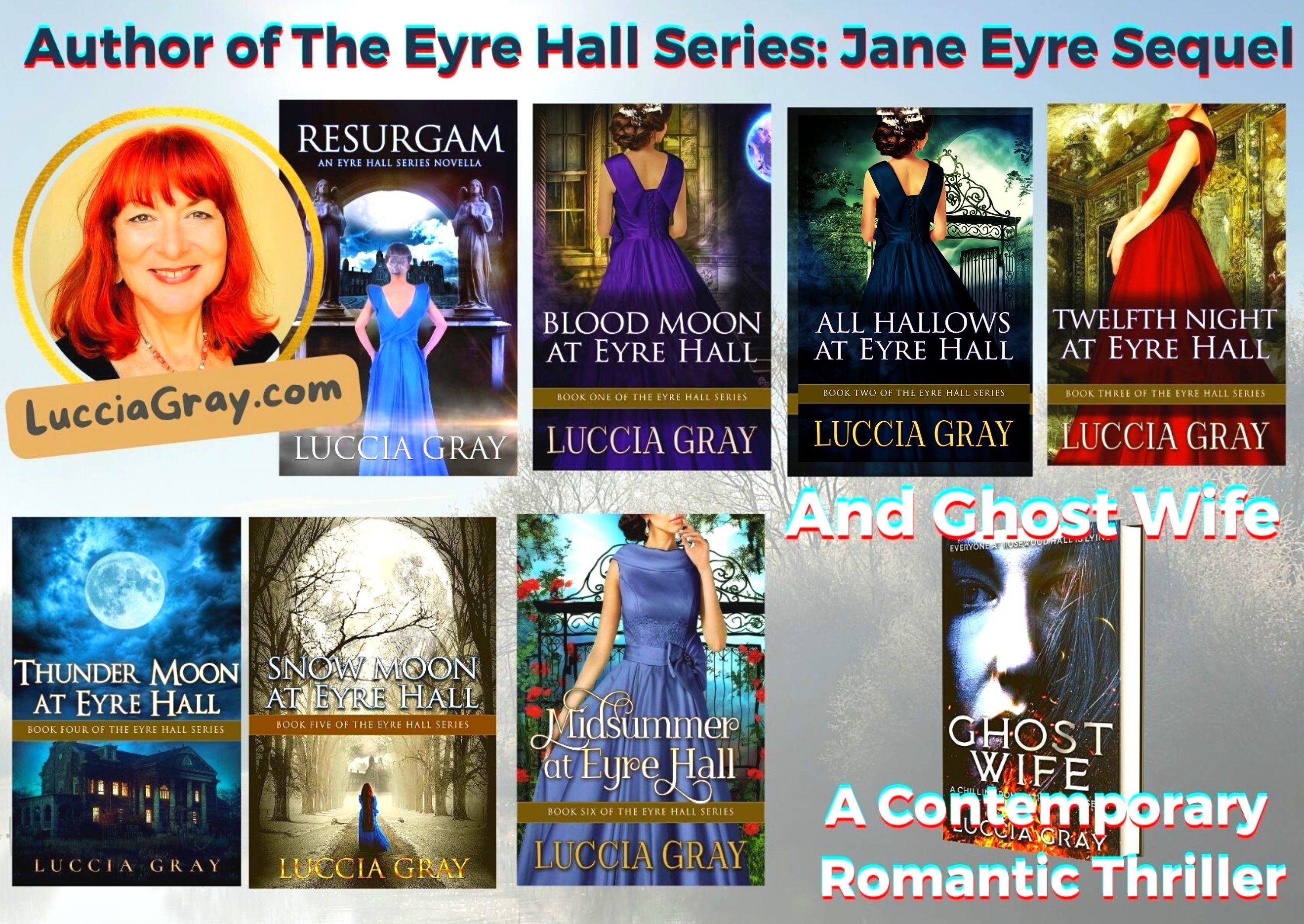
If you enjoy reading Victorian Gothic fiction, with plenty of romance, mystery, action, and suspense, you will love Twelfth Night at Eyre Hall, the second volume of The Eyre Hall Trilogy, which chronicles the lives and vicissitudes of the residents of Eyre Hall from the beginning to the height of the Victorian era.
Following Edward Rochester’s death, Jane Eyre, who has been blackmailed into marrying a man she despises, will have to cope with the return of the man she loved and lost. The secrets she has tried so hard to conceal must be disclosed, giving rise to unexpected events and more shocking revelations.
Romance, mystery, and excitement will unfold exploring the evolution of the original characters, and bringing to life new and intriguing ones, spinning a unique and absorbing narrative, which will move the action from the Yorkshire countryside, to Victorian London, and across the Atlantic Ocean to Colonial Jamaica.
Excerpts from Twelfth Night at Eyre Hall
Romance:
I was convinced I would never see him again. I had tried unsuccessfully to expel him from my thoughts, but he was always there, haunting my dreams and slipping into my mind during the day.
Suspense:
The morning after Twelfth Night, I had planned to leave London and return to Eyre Hall. I was having breakfast by the hearth at the inn, when someone crept up behind me and sat down in the chair to my right. I looked down at his unsteady hands, fearing he wished me no good. “Michael, I done it. I killed him.”
Gothic elements:
“Will you be responsible for Mr. Mason’s permanence in this house as one of the undead?” I roared impatiently. “What is it you want?” “To see the corpse and absorb his sins, of course.”
Mystery:
John stopped before a small casket which looked out of place inside a large niche positioned on the lower level, at the end wall of the vault, below Edward’s, and read, “Infant Eyre Rochester. May 1855.” He smiled at me, “Do not faint now, mother. You are going to see your baby again, at last.”
Adventure:
Hours later, we were woken by a wild raging storm, which tossed our ship mercilessly like a seashell on the shore. My whole body was shaken and turned inside out. It seemed my entrails desired to escape the storm by tearing out of my body. I looked out of the tiny port hole and saw a huge mass of water and dark objects spinning like a whirlpool, and I was thrust back against my desk.
I’m sure there are at least as many ways to write a novel as authors writing. In fact, there are probably more, because authors could even write each book in a different way.
I don’t know if my way of writing is the best way, it probably isn’t, because I’m fairly new to this profession, having only written two novels so far, but what I do know is that it’s the way that works for me.
I call it the layered approach. First I ‘see’ the chapter or scene I’m about to write. I imagine the conversation, situation, place, and or action which will take place, and when I feel confident about it, I start writing.
The first draft is often an outline, just so I don’t forget, because I have another full-time job and a family, and sometimes I just don’t have the time to develop the idea fully when the idea comes.
During the next stage, I keep thinking about and seeing the scene. I call it ‘summoning’, as I walk, drive, cook, or even dream. If I can, I talk to someone about it, if not I talk to myself about it.
Then I expand the outline, and I continue expanding the outline, with various layers, on different occasions. Each layer focuses on a different aspect, character, or part of the scene. The layering is repeated until I’m satisfied. Then comes the editing, which I consider the final layer.
This process can take days, weeks, or even months, because sometimes I leave the first drafts and return much later, after writing other scenes. I never write chronologically, that is in the order the book finally appears.
I plan the whole novel before I start, but it’s a very loose plan, because I know the characters grow as I write, which sometimes affects the plot, and even the ending. I want to make sure I’m writing with a goal but without constraints.
I imagine it’s like filming. I’m sure no director starts filming scene one and carries through filming in the same sequence as the final film appears at the cinema. I’m also pretty sure painters don’t start at the top of the canvass and finish at the bottom when they paint! The creative process is far too anarchic, eclectic, and subconscious, to follow a strict routine, although the final product looks deceptively ‘neat and tidy’.
Are you an artist? How do you create your work of art? Do you also do it like this?
****
This post was written in response to Linda G. Hill’s #SoCS: Friday prompt for Stream of Consciousness Saturday.
This week’s prompt is: Use the word “is” to begin your post – bonus points for using it (as a word on its own or at the end of your final word, i.e. “metamorphosis”) at the end of your post as well. Have fun!
Today’s insecurity is related to reviewing. Should I review every book I read or only those I enjoyed and would therefore recommend? Should writers review other writers publicly at all?
Most writers are avid readers, and some are also reviewers. It seems logical for writers who are readers to review the books they read, but is it always a good idea?
I must admit, I never used to review the books I read on Amazon, and I’ve been a regular amazon kindle and paperback customer for years. I used to think reviewing was for experts, until I started publishing myself, and realized how useful it is for other readers and helpful for authors, so I started reviewing many of the books I read from that moment onwards. At first, I thought it was a great idea, everyone wins.
Over a year later, with over 50 reviews on Amazon.com, and at least the same number on my blog, I’m not so sure it’s a good idea any more. I’m always kind when I review, because I know what an author has gone through in order to write and publish a book, but that doesn’t mean I’m not honest. On the other hand, if I don’t like the book, or think it needs more work, I sometimes tell the author privately, if I think the information can be useful, but I normally don’t review it publicly.
I’m convinced that my opinion will always be biased and therefore unjust. Why? Because although I have a solid linguistic and literary academic background, my opinion is not valuable enough to cause a negative effect on anyone’s ratings or self-confidence, after all, I may be wrong, since part of my opinion is linked to personal tastes and preferences.
I had planned to be away from the blogging universe for a month, which has become almost two months, because I’ve been investing all my time and effort into finishing my second novel and sequel to All Hallows at Eyre Hall, Twelfth Night at Eyre Hall, and it’s ‘almost’ there.
I now have a deadline to meet. Twelfth Night at Eyre Hall is available for pre-order and will be live on 28th of August. It is now in the beta reading, proof read and editing process.
I have also finally finished formatting and proofing All Hallows at Eyre Hall as a paperback edition, which is now available to purchase, too!
I have missed all my blogging friends, and very soon I plan to return to my usual posting and blog hopping and visiting!
Meanwhile I have the kindle version of All Hallows at Eyre Hall on offer from now until for 0.99 cents US or 0.99p UK.
All Hallows has been on Amazon Bestsellers list several times, last month on Amazon UK it has been #12 on the Amazon Best Seller lists for Victorian Historical Romance!
Just in case you still don’t know, it’s the Sequel to Jane Eyre, taking up her life twenty years after her marriage to Edward Rochester. It’s a Historical Gothic Romance set in Victorian England, and according to some of the reviewers it is: ‘Exciting, masterfully written, thoughtful, imaginative, suspenseful…’
I’m taking a one-month break from blogging, because I need to give Twelfth Night at Eyre Hallmy exclusive attention.
I’ll be popping in to visit the blogs I follow, on Twitter, and on Facebook, occasionally.
In June I plan to carry on with my Blog Posts and taking part in my usual Weekly Challenges, but right now I need to make room in my cluttered mind for Twelfth Night at Eyre Hall.
My final reflection after completing the A to Z April 2015 Challenge has two parts:
1) My theme was Author Spotlight, so the first part is a review of the 26 wonderful authors I have featured in my A-Z Challenge.
2) The second is an overview of all the blogs I visited during the challenge and why I enjoyed my visit.
**********
My featured authors made me think about love, good and evil, forgiveness and vengeance, relationships, our history, our future. They also made me laugh and cry, feel angry and happy. They frightened me, shocked me, and entertained me, but overall they made me think about myself, because every book I read teaches me something about myself as person and as a writer.
Here are all the featured authors and their blogs. They have all written wonderful books which have inspired me in the last six months. Check them out!
One of the most wonderful new discoveries has been Shailaja at her blog, The Moving Quill who has written wonderfully inspiring flash fiction throughout the challenge.
Thank you for all your wonderful posts, and congratulations for taking part and completing the challenge!
On Monday May 4th the Reflections Linky List will appear on this blog–The Blogging from A to Z Challenge Blog. Many authors will be adding their reflections, between today and Friday 8th May. Please visit and see what other participants have been doing and think about this challenge.
This post is written in response to Linda G. Hill’s prompt on Stream of Consciousness Saturday. Today’s theme is “compliment/complement.” Use one or use them both. Have fun! Anyone can join in! Enjoy posting and/or reading other posts here.
I’d like to take a few minutes to compliment myself, before Saturday ends. It’s not something I do very often, being far too critical and demanding of poor me.
Even though I do my best, it doesn’t seem like it’s enough, and it should be. Your best should always be enough, because there’s no more to give, without causing undue stress.
Today I’d like to compliment myself because a year ago I published my first novel, and I did my best, so that’s a success for me. No doubt there are plenty of much better and more successful books out there, but I couldn’t have done it any better, so I’m proud of All Hallows at Eyre Hall, and what I’ve achieved this past year. See my previous post for more details.
On the other hand, all compliments should have a complement. It’s no good patting yourself on the back and forgetting about it. You must move on and do something else to complement your compliment, thereby moving on in your abilities and objectives.
My compliment also has a complement, and that’s the second book in the trilogy which will be published next summer, Twelfth Night at Eyre Hall. See my previous post for more details.
Keeping my spirits up every day isn’t always as easy as it seems, but I have a little trick to perk myself up. A song. I have several, but Nobody does it better is one of my favourites.
I take it with me to the shower and sing my heart out while I lather up, so that ten minutes later, when I’m drying my hair, I’m on the top of the world! Sometimes, as the day progresses, I’m a little further down, but who cares, I shower every day!
Don’t forget to compliment yourself on your achievements, and complement them with some more achievements!
What makes you feel great when you’re a little down?











 Rereading Jane Eyre
