







And finally, I forgot to worry about everything I had lost over the years and remembered everything I had.
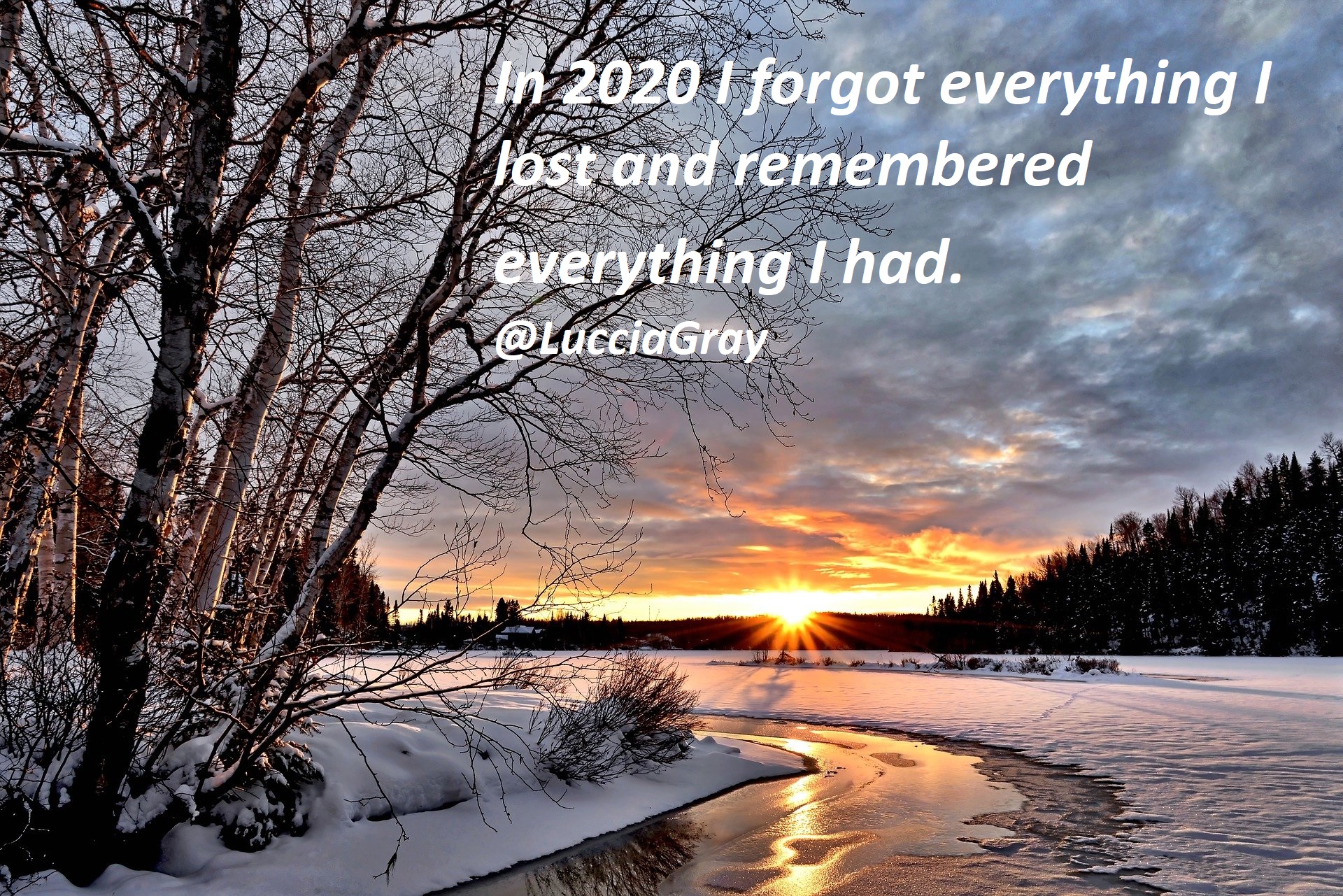

And finally, I forgot to worry about everything I had lost over the years and remembered everything I had.
This post was written in response to the Insecure Writer’s Support Group monthly (first Wednesday of every month) blog hop to where writers express thoughts, doubts and concerns about our profession. By the way, all writers are invited to join in!
Let’s rock the neurotic writing world! Our Twitter handle is @TheIWSG and hashtag is #IWSG
The awesome co-hosts for the January 6 posting of the IWSG are Ronel Janse van Vuuren , J Lenni Dorner, Gwen Gardner Sandra Cox, and Louise – Fundy Blue!
January 6 question – Being a writer, when you’re reading someone else’s work, what stops you from finishing a book/throws you out of the story/frustrates you the most about other people’s books?
Life is short, and getting shorter every day, and there are so many books to read that no one can read all the ones they’d like to read, so we have to pick carefully, and even then, if we’re not happy we can stop reading, because we don’t have to finish every book we start. I certainly don’t.
I’ve identified seven issues which could stop me finishing a book.
1- Unmet Expectations.
There are many reasons to read the first line of a new novel. But if it hasn’t been written or recommended by a fellow author or blogger, I decide to download a sample after reading the title and the blurb, although the cover also entices me!
If the book is described as a legal thriller, that is what I expect to read, and if I discover it has a dystopian setting, or it is a romance, I may not continue. On the other hand, I may like the writing style and proceed anyway.
2- Unlikeable characters
I don’t mean villains. I love villains, especially if they’re complex and part of the main plot, such as unreliable narrators!
An unlikeable character is one I can’t relate to, find irritating, whiney, or unbelievable. If there is only one, that may be ok, but if several characters, especially the main one, fall into this category, I will probably stop reading.
3- Poor editing
Repetition of events, words, phrases, too many adverbs, swear words, clichés etc. can put me off, but not always, because the characters and story can pull me in and persuade me to continue.
4- Trigger topics
We all have topics we do not want to read about explicitly, because they upset us. These topics are often related to sex, violence, drugs, trauma, etc.
I have a few personal ones, which is why the blurb should advise readers if the novel includes any sensitive topics.
5- Pacing
Sometimes I like the writing style and characters, but little seems to actually happen by means of a traditional plot. If I already know this might be the case because it’s what may be referred to as ‘literary fiction’ I may continue reading, anyway. But if I’m expecting a fast-paced thriller, according to the blurb, I would feel deceived and might not read on.
Contemporary readers, unlike Victorian readers who revelled in three-volume novels, are impatient and demanding, so books should respond to their audience’s needs.
6- Implausible plots
I prefer history and reality to fantasy, so I don’t read a lot of fantasy. I’m not happy when novels take a sudden and implausible supernatural twist and I might not read on, although other factors, such as writing style and characters might keep me reading.
I like plot twists and unexpected turnings, and even open endings, but loopholes in plots or ones that work out because of a sudden implausible event, or novels that drop a plot line or character in the middle are often annoying.
7- Writing style
This is a make or break one for me. I can read about any topic if I like the way it’s written, sci-fi, fantasy, vampires, erotica, westerns, warfare; it doesn’t matter if the writing draws me in.
The problem is, I have no idea how that happens.
I believe it when they say agents read the first line, paragraph or page and decide if they want to read the book, because I do exactly the same. I only carry on regardless if it’s one of my many favourite authors, or if it has been recommended by someone I trust.
So, what’s the secret to drawing the reader in?

I have this quote pinned on the wall in my study and I read it every day, hoping it will inspire me, because it’s the hardest and most important thing to do as a writer.
Not only the opening line of a novel, but I’d apply this proposal to every chapter, because you need to get the reader hooked on the first page and continue reading after the first paragraph of every chapter.
So, what makes you stop reading a novel?
By the way! Happy New Year!

Over the past months I’ve been reading a great number of motivational and inspiring books on the topic of personal growth. I’ve also been listening to podcasts and watching videos on YouTube. This interest has sprung from a combination of factors as I’ve recently reached a few significant milestones in my life; I retired and turned sixty, and I have five grandchildren between the ages of three months and nine years. I am concerned with aging, health, and emotional wellbeing, as well as my children’s and grandchildren’s future challenges. I have more time to reflect and more things to reflect on, so I’ve found these books, podcasts and videos very helpful, especially in these uncertain and volatile times in which we can take nothing for granted. I’ll be sharing my thoughts with you on Mondays.
Today’s book is very appropriate for this time of year, because it’s all about Setting Goals for 2021.
I read Michael Hyatt’s Best Year Ever in 2018 and used it to plan my 2019, but I haven’t used it this year. I took careful notes, as I always do, and remembered that he included useful strategies and questions to help us look back on the previous year, and our lives in general, in order to make and plan goals for the following year.
![Your Best Year Ever: A 5-Step Plan for Achieving Your Most Important Goals by [Michael Hyatt]](https://m.media-amazon.com/images/I/51dB0rpsXoL.jpg)
The first stage is taking the Lifescore Assessment Questionnaire in the book, which I’ve now found online as an online tool, which I had used in the book and scored 75% in 2019 and this year I scored 89% which is even better. You can take the test yourself here.
I have had a complicated year, but the complications have developed favourably, so I am fortunate enough to feel fairly satisfied with this last challenging year. It hasn’t all been due to my efforts, I’ll admit that I have been lucky, or perhaps I’ve attracted luck through my visualisation and positive attitude. I have also adapted well to the imposed changes in our lives because of covid-19 and especially confinement issues. I believe that the vast number of books I’ve read and am sharing with you on #MondayBlogs and podcasts and videos on personal growth, time management and goal setting have helped enormously and I hope some of these books and authors will also resonate with you.
Returning to Michael Hyatt, he suggests that we divide our life into ten domains: Spiritual, Intellectual, emotional, physical. Marital, Parental, Social, Vocational/Professional, Vocational/Hobbies and Financial. At first I thought they were too many, but as I read on and applied them to my life, they started making sense, with some minor adaptations. The questionnaire is based on these 10 domains.
Then he suggests we follow these five stages to achieve our goals:
He goes into each one in great depth individually and proposes practical activities we can do to help us achieve our goals.

I’d like to tell you about Stage Two, Getting Closure of last year in order to move on. I hope it will be useful, now is the time to review the years which about to end.
He proposes we think about and write answers to the following 9 questions bearing in mind the ten life domains:
Hyatt suggests we write 7-10 goals including all the domains for the following year, based on the results of our test and our answers to the previous questions.
What do we want next year to look like in the 10 domains?
Which goals will help us fulfil our dreams for the year ahead?
Then he asks us to do a very powerful exercise: Visualise the end of the year when we have achieved our goals and describe our life and our feelings. We can also write it down, self-talk about it, or meditate and visualise our new lives.
To summarise and simplify this part of Hyatt’s proposal, I suggest that the following three activities will help us take the first steps in setting our goals for the year.
1- Taking stock of the past as something that has happened FOR us not TO us. We have to grow as a result of past experiences and make a conscious effort to learn the lesson and move on.
2- Setting goals for the year ahead based on prioritising our needs in each domain.
3- Visualising what our future looks and feels like with our achieved goals.

I urge you to read the rest of the book, or other books on strategies for achieving our goals, because a goal without a plan is a wish and we need to make our goals become real in 2021 by conscious strategies and visualisation.
I wish you all the best of luck for the year ahead. I hope you achieve all your goals in 2021.
Here’s the link if you’d like to read my other posts on #PersonalGrowth
 I remembered to say I love you more often.
 I remembered to feel joy at every sunrise.
 I remembered to feel satisfaction at every sunset.
 I remembered to feel hope that tomorrow will be even better than today.
 I remembered to learn something new every day.

And remember…
Over the past months I’ve been reading a great number of motivational and inspiring books on the topic of personal growth. I’ve also been listening to podcasts and watching videos on YouTube. This interest has sprung from a combination of factors as I’ve recently reached a few significant milestones in my life; I retired and turned sixty, and I have five grandchildren between the ages of three months and nine years. I am concerned with aging, health, and emotional wellbeing, as well as my children’s and grandchildren’s future challenges. I have more time to reflect and more things to reflect on, so I’ve found these books, podcasts and videos very helpful, especially in these uncertain and volatile times in which we can take nothing for granted. I’ll be sharing my thoughts with you on Mondays.
This Monday I’m featuring 168 Hours: You Have More Time Than You Think, written by Laura Vanderkam, a book which has helped me realise I have much more time than I ever imagined, and although I thought I was good at planning, this books has made me realise I can use my time much more efficiently.
In this brilliant book, the author reminds us that every week has 168 hours, which is plenty of time to do everything we want and need to do, as long as we follow her advice and find ways to rearrange our schedules to make room for the things that matter most. This book gives us plenty of creative and eye-opening ideas, to do just that.
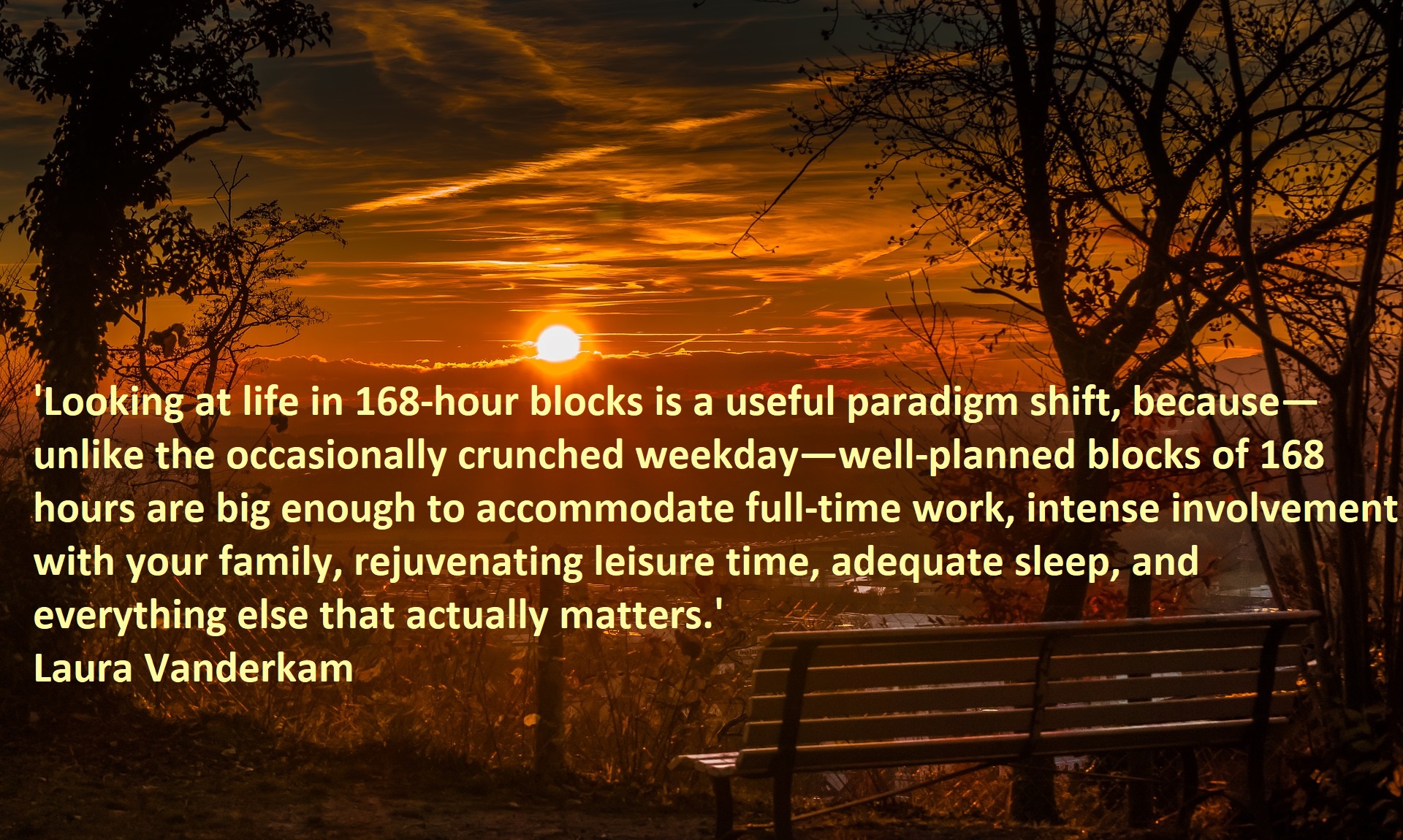
In the introduction, she suggests, ‘Looking at life in 168-hour blocks is a useful paradigm shift, because—unlike the occasionally crunched weekday—well-planned blocks of 168 hours are big enough to accommodate full-time work, intense involvement with your family, rejuvenating leisure time, adequate sleep, and everything else that actually matters.’
I took several pages of notes as I listened to her Ted Talk first, and then went on to read her book, 168 Hours, so what follows is a brief synthesis of the ideas I consider most inspiring and helpful, but I urge you to listen to her and read her book, because it will help you to identify the things that really matter in your life, take control of your week and find time for everything you desire.
![168 Hours: You Have More Time Than You Think by [Laura Vanderkam]](https://m.media-amazon.com/images/I/41A52WOaYBL.jpg)
A week has 168 hours, we work for 40 and sleep for 56, which means we have 71 hours left. That’s a long time! Some people commute 2 hours a day, that’s 10 hours less, 61. Let’s subtract say 2 hours to eat and 2 for housework and shopping, that’s 28, which still leaves us 33 hours a week of free time.
The secret to optimising that free time between family, friends, hobbies, exercise, and relaxation, is:
a) being aware of the time at your disposal and how you are using it every week and b) being intentional about how you use this time.
In order to gain awareness of how we’re spending our time, she recommends using a spreadsheet you can download from her blog My168Hours.com, or create your own.
We should later analyse how we’re spending our time acording to categories such as child care, which can be subdivided into physical care, playing, education, and reading, for example. Housework, which can be divided into laundry, food prep, house cleaning, lawn work, and so on.
Another inspiring proposal is the suggestion that we write a list of 100 dreams and make sure we’re working towards one or more of them every week, and cross them off as we complete them.
Setting goals, prioritising from work to household chores, identifying what’s important, urgent and what can be delegated or postponed, long and short term goal planning, downtime, creating a weekly, block schedule and so much more is contained in these 271 priceless pages.
I absolutely loved this book! It’s useful for everyone and anyone, whether you’re a stressed CEO, a busy mother or father, or a student. There’s so much useful and practical information and food for thought that it’s one of the best and most useful books on time management I’ve ever read.
168 Hours is especially useful at this time of year when we’re more likely to assess our past year and plan for next year’s goals.
If you listen to and read Laura Vanderkam’s proposals, I guarantee you’ll have a greater chance of finding happiness and reaching your goals.
Here’s the link if you’d like to read my other posts on #PersonalGrowth

 Bare trees, russet leaves,

Over the past months I’ve been reading a great number of motivatioal and inspiring books on the topic of personal growth. I’ve also been listening to podcasts and watching videos on YouTube. This interest has sprung from a combination of factors as I’ve recently reached a few significant milestones in my life; I retired and turned sixty, and I have five grandchildren between the ages of three months and nine years. I am concerned with aging, health, and emotional wellbeing, as well as my children’s and grandchildren’s future challenges. I have more time to reflect and more things to reflect on, so I’ve found these books, podcasts and videos very helpful, especially in these uncertain and volatile times in which we can take nothing for granted. I’ll be sharing my thoughts with you on Mondays.
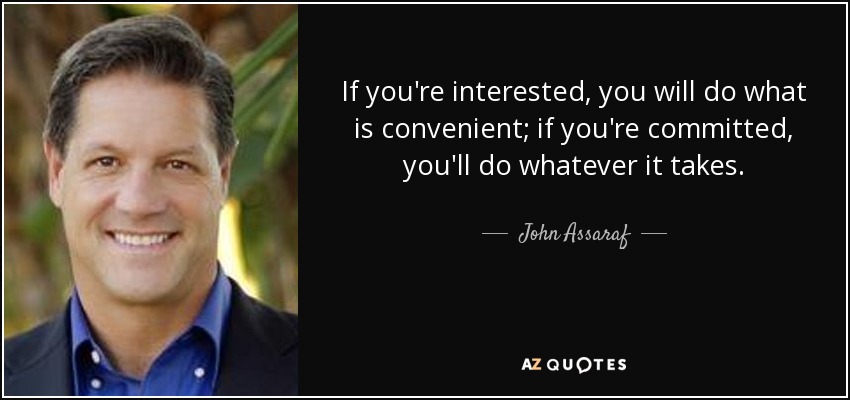
This Monday I’m featuring a book which has enlightened me in my goal-setting strategies called Having It All, written by John Assaraf.
Having It All gives us the tools to achieve any type of goal we have will take you from where you are to where you want to be. John Assaraf started with nothing, in fact it was less than nothing, because when he was young he became part of a gang and was involved in petty crimes, until he met his mentor and his life gradually improved to one of outstanding success. In the first chapters, he tells us about his early years and his life before he realized his capacity to change and achieve his goals.
Today John Assaraf is one of the leading mindset and behavioral experts in the world. John has built 5 multimillion dollar companies, written several New York Times Bestselling books. He also took part in the documentary, “The Secret”.
I listened to the audiobook which has the advantage of listening to the author himself giving us specific and helpful advice with useful strategies to identify your goals, eliminate obstacles and achieve our dreams, using both conscious and practical approaches, as well as the power of our subconscious minds to develop empowering success habits.
![Having It All: Achieving Your Life's Goals and Dreams by [John Assaraf, Bob Proctor]](https://m.media-amazon.com/images/I/51xfnEUevtL.jpg)
I took several pages of notes as I listened to his book, but I’ll just tell you about a few of the proposals which most inspired me.
He reminds us that every goal starts as a thought and inspires us by stating that if we have a desire, we also have the ability to achieve it.
He urges us to identify our goal, but we must be specific, use precise language and formulate it in the present tense as an affirmation. Then we should visualise it happening during our daily meditations in order to transfer it to the subconscious mind, as part of our daily rituals.
Then he identifies 7 power factors to achieve the goal: Persistence, attitude, discipline, vision, focus and action, which we can only carry through if we revise our daily habits and create new ones which will focus on actively achieving our goals.
We also need to revise our implicit and explicit beliefs related to the goal, which could be acting against us as negative blocks. We should identify our negative beliefs and reformulate them in a positive manner to create a new belief.
He explains it himself in the following YouTube video.
I found his book helpful in my goal setting. He made me see the difference between being a goal setter and a goal achiever. I did feel that sometimes the examples were too focused on goals involving financial gains, whereas I would have liked more proposals regarding creative endeavours.
Becoming wealthy has never been a goal in my life, but I can apply his proposals for other types of goals, such as being a successful author.
 Here’s the link if you’d like to read my other posts on #PersonalGrowth
Over the past months I’ve been reading a great number of motivatioal and inspiring books on the topic of personal growth. I’ve also been listening to podcasts and watching videos on YouTube. This interest has sprung from a combination of factors as I’ve recently reached a few significant milestones in my life; I retired and turned sixty and I have five grandchildren between the ages of three months and nine years. I am concerned with aging, health, and emotional wellbeing, as well as my children and grandchildren’s future challenges. I have more time to reflect and more things to reflect on, so I’ve found these books, podcasts and videos very helpful, especially in these uncertain and volatile times in which nothing can be taken for granted. I’ll be sharing my thoughts with you on Mondays.
This Monday I’m feauring a book called The 5am Club: Own Your Morning, Elevate Your Life, another useful book about taking control of your mornings from the moment we wake up and making the rest of that as good as it can be.
The first thing I have to say is that I read the book some months ago with no intention of getting up at 5am, beacuse I’m fortunate enough to be retired and my own boss, so I own my whole day.
I do help with my grandchildren regularly, but I don’t have the responsibility of looking look after a family. Also, I’m retired from my previous salaried employment, as a teacher and professor, and although I’m a writer, which means I write for several hours every day, I don’t have a strict timetable, and I love reading late at night, so 5am doesn’t work for me, at the moment.
You may wonder why I read this book and if I found it helpful. Well, I read it because I wanted to reaffirm and improve my morning routine, which we all have, even if we don’ call it that or verbalise it specifically. This book has helped me do just that; Understand the value of having a morning routine and making sure the three key aspects Robin Sharma talks about, activating mind, body and soul, are consciously inbedded, in some way, throughout my morning.
By the way, I’ll be telling you all about my morning routine, next week!
![The 5 AM Club: Own Your Morning. Elevate Your Life. by [Robin Sharma]](https://m.media-amazon.com/images/I/41QKRLgR0uL.jpg)
Leadership and elite performance expert Robin Sharma introduced The 5am Club concept over twenty years ago, based on a revolutionary morning routine that has helped his clients maximize their productivity, activate their best health, and bulletproof their serenity in this age of overwhelming complexity.
Robin Sharma explains, by means of ample examples and through a dialogue between a tycoon and his menor, how the habit of early-rising has helped so many successful people accomplish epic results while upgrading their happiness, helpfulness and feelings of aliveness.
He proposes a formula to wake up early feeling inspired, full of energy and focused. One of the key concepts is that getting up while everyone is sleeping gives us precious time to think, express our creativity and begin the day peacefully instead of running around in a mad rush to keep up with life’s demands and transform our lives.
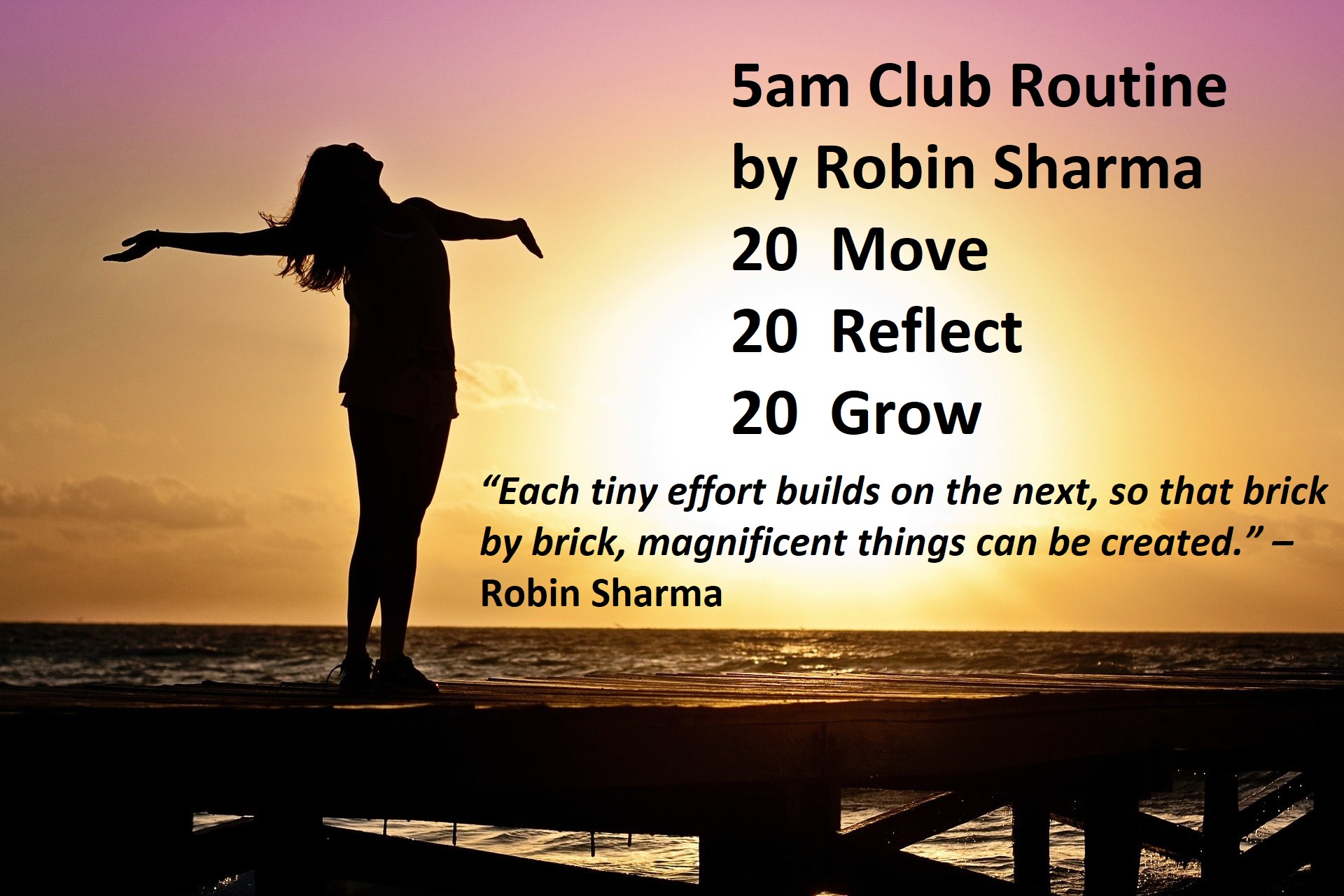
The most practical and well-known part of the book, is his 20/20/20 rule. He suggests we reserve the first 60 minutes of our day for personal preparation.
The first 20 minutes should be spent doing intense exercise, because sweating releases BDNF, a brain chemical that grows neural connections. Working out also releases dopamine (the neurotransmitter of motivation) and serotonin, which makes you feel happy.
The second 20 minutes should be spent reflecting on our long term annual plans and goals. This can be done by journaling, meditation, etc. Because this will deepen our focus throughout the day.
The final 20 minutes of our mornings should be spent learning something, reading, or listening to a podcast, basically feeding our minds.
Robin Sharma has plenty of material on his blog where you can learn more about his proposals.
He also has a great YouTube channel where you can listen to him tell you all about how to make the most of your morning, improve your well-being and be successful in whatever you do.
I like the idea of tending to you body, soul and mind, every day, at the start of the day, before you begin your ‘real’ daily demands of life and work, and I think it’s great for busy people. I can see how this routine could help a certain type of young, very active and ambitious person.
However, I’m in a different stage of my life, and although I make sure I’m actively and consciously tending to my mind, body and soul every single day, I don’t think I have to do it at 5am, or in that order, or even all at once.
Do you think waking up at 5am would work for you?
Here’s the link if you’d like to read my other posts on #PersonalGrowth
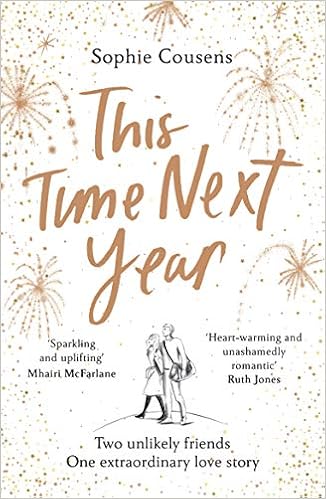
Today I’m reviewing another romantic comedy, This Time Next Year by Sophie Cousens, which has been hailed as ‘2020’s most perfect pick-me-up. Refreshingly romantic and certain to hold a special place in your heart.’ It is set in London, mostly on and around 2020 New Year’s Celebrations.
From the Blurb
Quinn and Minnie are born on New Year’s Eve, in the same hospital, one minute apart.
Their lives may begin together, but their worlds couldn’t be more different.
Thirty years later they find themselves together again in the same place, at the same time.
What if fate is trying to bring them together?
Maybe it’s time to take a chance on love…
****
My Review
This Time Next Year, is an uplifting and engaging, quick and fun novel, which I read in one sitting. It reminded me of One Day by David Nicholls, but it’s a much shorter and less intense version of a love story, and it has a happy ending.
The plot revolves around Quinn and Minnie’s meeting on New Year’s Eve, 2019 and ends on the same day in 2020. in between we get flashbacks to previous New Year’s Eves, when they almost met, and various meetings throughout 2020, told mainly from both protagonists points of view, in third person.
It is a slow burn, sweet love story, which gradually unfolds as Quinn and Minnie come face with their emotional issues, and work towards overcoming them. They are both likeable characters, trying to grow emotionally, and the way their relationship develops is believable and sweet. There are also plenty of laugh out loud moments, as well as challenging moments, in their relationship.
I also enjoyed reading about Quinn and Minnie’s parents, who had met when Quinn and Minnie were born, as they shared a room at the hospital. Thirty years later, Minnie’s parents and Quinn’s mother re-established contact and something very special happens (no spoilers, you’ll have to read it to find out!).
The setting, in London, and mostly in the upcoming festive season, was another engaging aspect. It’s definitely worth reading on a cosy, winter afternoon-evening.

 Rereading Jane Eyre